



By Jen Russel
Republished from The Woodbury Warbler
NEW JERSEY — Verizon and several of its affiliated telephone companies have jointly asked the FCC for authority to discontinue traditional copper-based landline service in portions of nine states, including New Jersey. The application is broader than the Verizon name suggests: it also includes several affiliated telephone companies doing business as Frontier, so customers who know their provider as Frontier should not assume the filing does not apply to them.
The company’s Aug. 10 application seeks authority to discontinue what is commonly called “plain old telephone service,” or POTS, delivered over copper lines. Verizon says only about 277,000 residential and business copper voice lines remain in use across the nine states included in the application, representing less than 2.25% of locations where the service could be offered.
If the FCC approves the request, Verizon says it could begin discontinuing the service on or after Oct. 23, 2026. The company mailed notices to customers in the proposed discontinuance areas on Aug. 10.
The FCC is accepting public comments through Thursday, Sept. 10, under WC Docket No. 26-227.
Verizon says it is seeking to discontinue copper service only at locations where customers can obtain another qualifying voice service, either from Verizon or another provider. Those alternatives may include fiber- or cable-based Voice over Internet Protocol, Verizon fixed-wireless home phone service, or mobile wireless service.
But whether those alternatives are truly equivalent may matter considerably depending on where a customer lives and what the telephone line is used for.
What happens when the power goes out?
That question is particularly relevant in South Jersey this week, where Tuesday night’s severe storms left large numbers of residents without power and knocked out internet service at the Mantua Township Police Department, although police remained able to respond to emergency calls.
Verizon’s own application acknowledges an important difference between traditional copper service and many of the proposed replacements: the replacement equipment may depend on electricity or battery backup.
For Verizon’s fixed-wireless home phone equipment, the company says typical battery backup can last up to 24 hours, but customers are responsible for obtaining and maintaining the batteries needed to keep the equipment working. Without electrical or battery power, the device will not function, including for 911 calls.
Verizon says its Fios Digital Voice equipment also provides up to 24 hours of battery backup under typical conditions, but fiber service does not supply power through the telephone line. Customers are responsible for replacement batteries during extended outages.
Mobile phones likewise depend on their own battery or another source of electricity. Verizon’s application says customers experiencing longer outages may need to recharge phones using a vehicle, laptop or power bank and acknowledges that a phone without power cannot make or receive calls, including 911 calls.
Cable- and fiber-based telephone services from other providers may have similar limitations. Verizon’s filing notes that those services do not supply power through the telephone line and may require battery backup to remain available during an outage.
That does not mean every customer is better served by keeping copper. For many households, fiber, cable or wireless telephone service may work perfectly well. But for residents in cellular dead zones, areas prone to prolonged outages, or households using a telephone line for medical monitoring, alarms or other essential equipment, the distinction may be significant.
Why Verizon wants to retire the cooper network
Verizon’s argument is essentially that maintaining the old copper network no longer makes economic or technological sense as fewer customers use it.
The company says the cost of maintaining traditional copper-based service has risen sharply because of aging infrastructure, increasing copper prices, difficulty obtaining replacement parts and theft. At the same time, the number of customers using the service has fallen substantially, making each remaining copper line more expensive to maintain. Verizon argues that money spent maintaining that network could instead be invested in fiber and wireless infrastructure.
Verizon also points to the broader decline in landline use. Its filing says copper-line subscriptions nationally fell 81% between 2014 and 2024, and that fewer than 2.25% of consumers who could subscribe to Verizon’s copper voice service in the nine states covered by the application still do so.
The company describes the proposal as part of a larger transition away from older telephone networks and toward fiber, cable and wireless services. Verizon says it is seeking permission to discontinue copper service only where customers can obtain a qualifying replacement service from Verizon or another provider.
What readers told us
After The Woodbury Warbler posted about Verizon’s application, readers raised concerns that went beyond whether they simply prefer having a traditional landline.
Several readers said they or people they know had already received letters from Verizon and understood the discontinuation to be a done deal, rather than a proposal still awaiting FCC approval. One said the letters were “worded as if it’s a done deal,” while another said she understood hers to mean permission had already been granted.
The full exemplar notice provided by Verizon in its FCC filing does explain that customers may object and submit comments to the FCC. However, those instructions appear in a separate FCC-required notice following the customer letter. Several readers who received Verizon communications told the Warbler they nevertheless understood the discontinuation to be a completed decision rather than a proposal still awaiting FCC approval.
Other readers described practical reasons they continue to depend on a landline.
One said her line is used for pacemaker monitoring and for emergency messages from police and weather services. Another said her residential elevator requires a landline. Other commenters raised concerns about elevator telephones requiring landline access in commercial buildings and the difficulty and expense of retrofitting wireless service; poor cellular reception; and using landlines as an emergency backup where cell service is unreliable.
For customers who rely on a copper line for something more than ordinary telephone calls, however, identifying an available replacement service may not resolve the problem. They may need to determine whether existing medical, alarm, or building equipment is compatible with a new service, obtain replacement equipment or adapters, arrange installation or reconfiguration, and determine how that equipment will continue operating during a power outage. Those steps may also impose costs and require technical knowledge or assistance that some customers, particularly elderly, disabled or medically vulnerable residents, may not readily have.
Verizon’s filing also acknowledges that wireless, fiber, and cable-based replacement services may require customer equipment and battery backup, and that without sufficient power those services may fail, including for 911 calls. In some cases, customers are responsible for obtaining and maintaining the backup power needed to keep service operating during an outage.
Readers also questioned whether wireless service is a meaningful replacement everywhere. One commenter said thousands of people in the area had trouble using cell phones during this week’s outage, while another said her household keeps a landline specifically because cellular service is poor.
Verizon’s application relies, in part, on the availability of wireless, fiber, or cable alternatives to argue that affected customers will have an adequate replacement for copper service.
What should you tell the FCC?
The notice included in Verizon’s application tells customers exactly what the FCC wants to know.
The FCC says comments should include specific information about how the proposed discontinuance would affect the commenter, including any inability to obtain a reasonable substitute service.
That could include firsthand information about:
- weak or nonexistent cellular coverage at your home;
- frequent or prolonged power outages;
- the availability, reliability or cost of fiber, cable or wireless alternatives;
- reliance on a copper landline for 911, medical monitoring, alarms or other essential equipment; or
- other reasons an available replacement may not actually be a reasonable substitute for your current service.
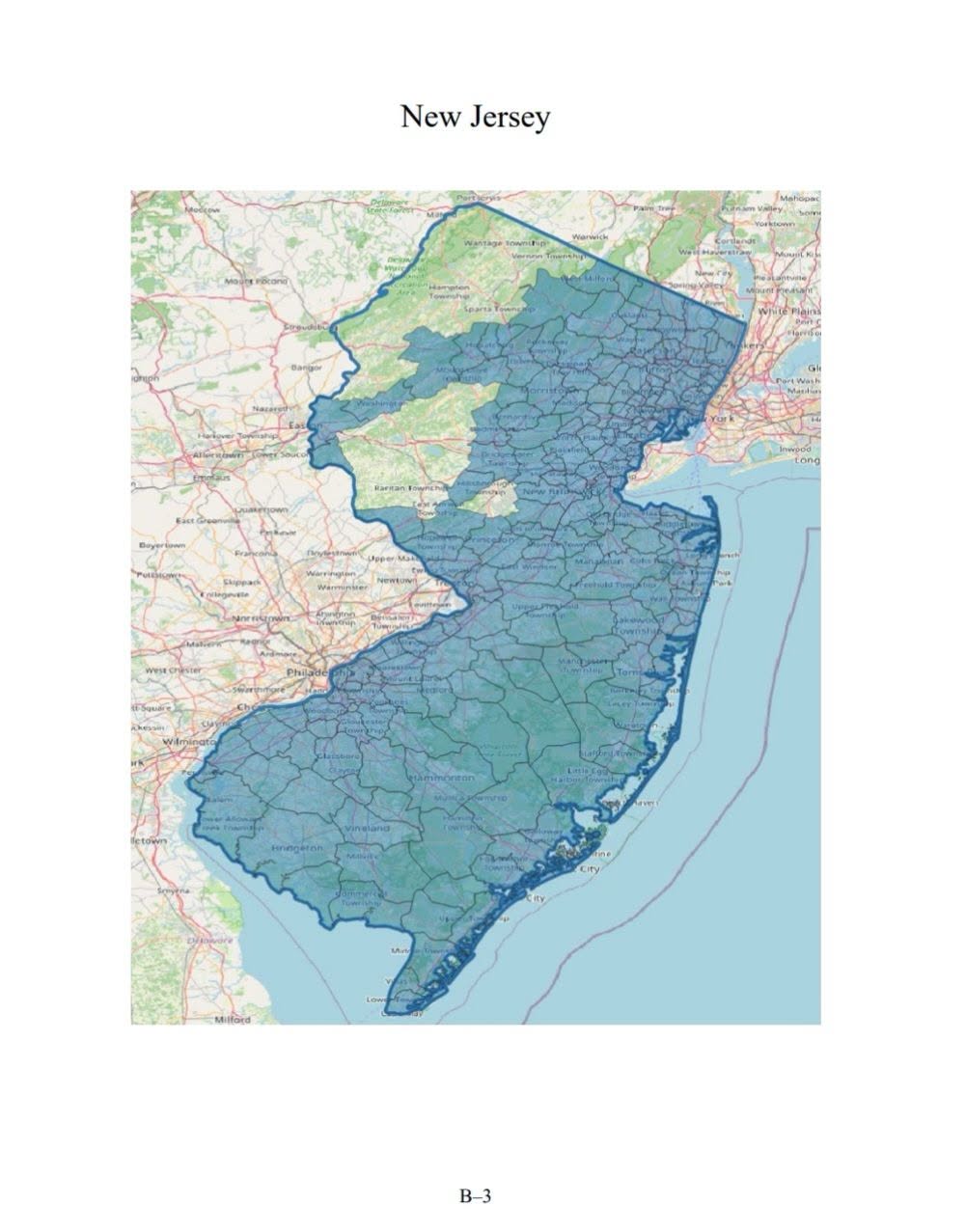
Verizon’s application includes a statewide map showing the boundaries of its New Jersey telephone service territory. The application says the proposed discontinuance applies within those service areas where Verizon contends an adequate replacement service is available.
Comments are due Thursday, Sept. 10, under WC Docket No. 26-227.
How can you submit a comment?
Before you get started, write your comment and save it as a Word document, PDF, Excel spreadsheet, or if you’re feeling fancy, a PowerPoint (these are the common document formats the submission portal accepts).
To submit your comment, use the FCC Submit a Standard Filing Portal. When you click this link, you should see a portal with the docket number populated. If you don’t see the docket number (26-227) populated in the top field, type the docket number there. Type your name in the Name(s) of Filer(s) field, and your email address in the Primary Contact E-Mail field.
What about those with limit and unstable inter connections and those who have pacemakers and other medical equipment that uses a land line or those who are on house arrest and Salem county has many dead zones
This is not okay! Our landline has been the single most thing that we could rely on for our children and for our home. Multiple times our power has gone out our phones do not work on the grid because it’s awful out here but our landline does work! This is not looking good. What are we moving towards? Lost communication? Internet doesn’t work cell phones don’t work and now taking the landline? We all have to get satellite phones? I rely on the landline to keep my kids safe at home.
If people choose to keep and pay for landlines should be at their option. Cell phones are not reliable. Thus, leaving people with medical issues at risk. Also, to attempt to contact authorities for emergency services are at risk if the towers go down. Seniors are being placed at risk due to financially unable to pay for cell phones and or unable to physically or mentally operate a cell phone.