

A news release from Salem County defends the purchase and points to falling overdose deaths. It gives no dollar figures, no specific plan for the $1.2 million still unspent and does not name who makes the spending decisions.
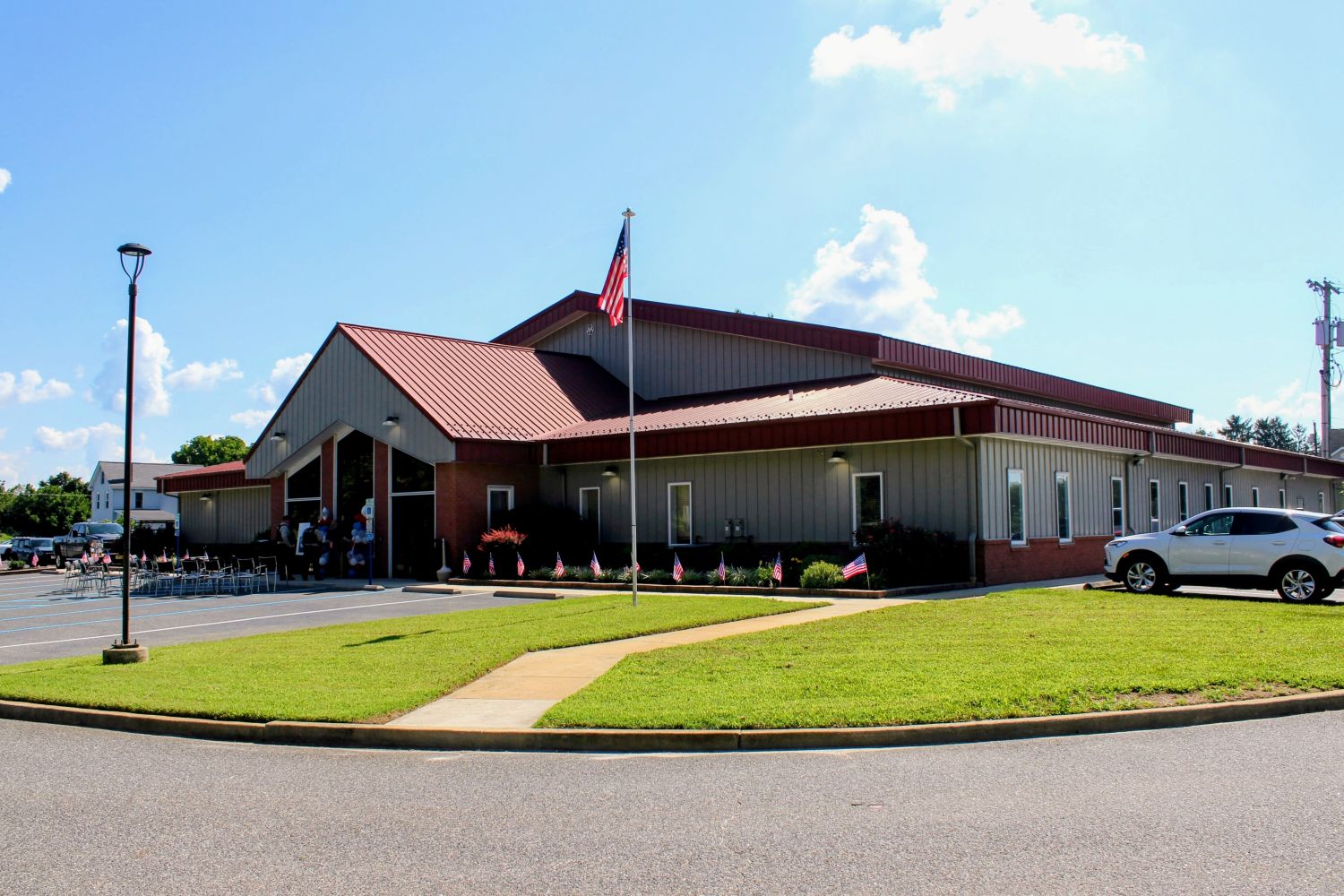
Salem County earlier this week defended its use of national opioid settlement money to help buy the Sharptown building that now serves as its Health and Human Services Senior & Community Center, calling the purchase “an allowable use” of the funds.
The four-page news release, sent at 12:53 p.m. Monday by Deputy Administrator, Clerk of the Board and public information officer Stacy Pennington, follows The News of Salem County‘s report that the county used about $605,000 in settlement money toward the building and charged another $123,237 to the settlement fund for the building’s emergency generator.
The release lists the programs offered at the center and says the county “recognizes the importance of transparency and accountability when it comes to public funding, particularly funds designated to address the opioid crisis.” It does not give any dollar figures, and it does not answer follow-up questions The News of Salem County sent to Health and Human Services Director June Sieber and Mental Health and Substance Abuse Division Director Chance VanDover, which remain unanswered.
Link to original story by Zachary Ahl of The News of Salem County.
“More than a building”
The release describes the center as a home base for five Health and Human Services divisions: the Office on Aging & Disabilities, Mental Health & Addiction Services, Public Health Nursing, Public Preparedness and Environmental Health.
“While the Senior & Community Center provides a welcoming space for older adults, its purpose extends well beyond senior programming,” it says. It closes: “The Senior & Community Center is more than a building. It is an investment in our community, our residents, and the future of health and human services in Salem County.”
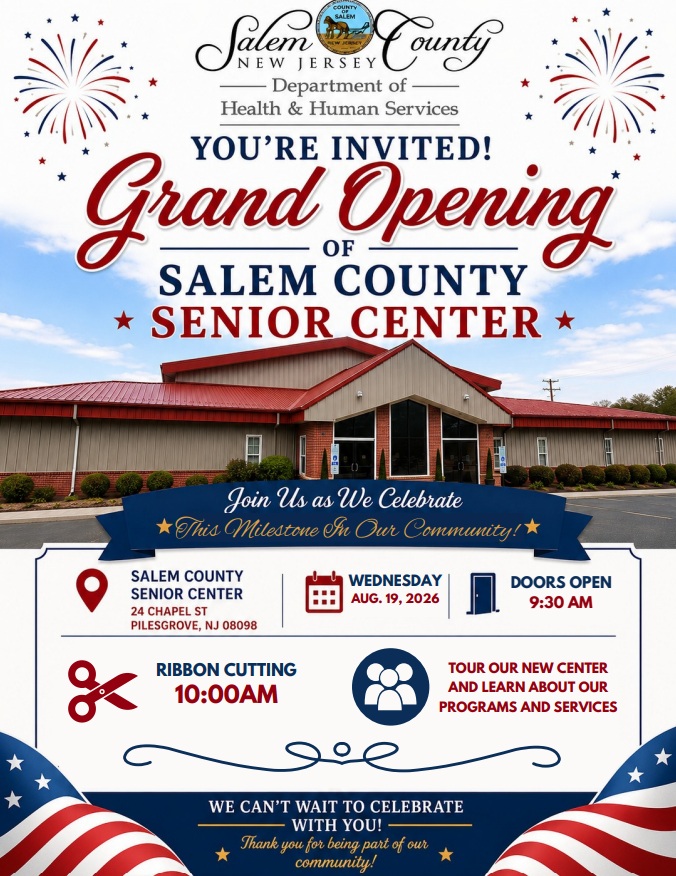
The department’s own invitation to the Aug. 19 opening described the building differently. Under the heading “You’re Invited!”, it announced the “Grand Opening of Salem County Senior Center” and invited residents to “tour our new center and learn about our programs and services.” It did not mention a community center, substance use or recovery programs, or a clinic.
Senior programs listed include monthly luncheons, a new JOY Club, walking, yoga, tai chi and chair exercise classes, crafts and games, and the Healing Hearts grief support group. Other divisions offer free blood pressure, cholesterol and glucose screenings, childhood lead screenings, flu and COVID-19 shots, CPR and first aid classes, and ServSafe food safety certification. The building is also designated as an emergency site for distributing medications and vaccines.
For substance use, the release lists programs that “opioid settlement funds, other grant funding, and match funding have supported,” including:
- Grief support groups for people who lost a loved one to overdose
- Monthly Narcan training and harm reduction services
- Outreach by trained recovery coaches to connect people to treatment
- Medication lock box giveaways and sharps disposal
- “Not My Kid,” a mock teen bedroom tour showing parents signs of risky behavior
- Prevention education in county high schools and a program on substance misuse for seniors
- Monthly recovery events and the annual Opioid Summit
- Crisis intervention training for police
- “Direct resident services, including treatment stays, recovery coaching, detox and short-term residential care, sober living, and transportation assistance”
The release does not say which of these settlement money paid for, or how much each cost. In its reports to the state, the county lists four programs paid for with settlement money: community outreach, harm reduction supplies, “recovery supports” (sober-living help and, last year, the building) and its Overdose Fatality Review Team.
The release says a planned clinic space “will create additional opportunities to connect individuals with recovery coaches and support services,” and will let the nursing division expand services. It gives no timeline. In an Oct. 30 email, Sieber described the clinic as “still in discussions and planning phases.”
“Section J”
The release states that settlement money “supported the acquisition of the Senior & Community Center, an allowable use under Section J of the List of Opioid Remediation Uses, which specifically includes infrastructure supporting recovery, access to care, and connection to treatment.”
That list, adopted by New Jersey from the national settlements, sets out the approved ways local governments can spend the money. Section J is titled “Leadership, Planning and Coordination.” The item in it that mentions infrastructure reads, in part, “Invest in infrastructure or staffing at government or not-for-profit agencies,” for collaborative coordination across systems to prevent opioid misuse and overdoses and to treat and support people with opioid use disorder. The list does not mention buying buildings or real estate.
The state Department of Human Services oversees the settlement program in New Jersey. A July 2025 report by the state comptroller found the department does not consider itself responsible for overseeing how local governments spend the money, beyond collecting their annual reports.
The release says the acquisition, renovations, supplies and infrastructure for the building “involved a variety of additional grant funding sources,” without naming them. Sieber said in October that the purchase was paid for with about $605,000 in settlement money and $429,730 in federal CDBG-CV2 pandemic relief funds, and included a lot on Green Street that is not mentioned in the resolution authorizing the purchase.
Overdose deaths are down
The release cites Tri-County Medical Examiner data showing “an 81.4% decline in fatal overdoses from 2019 to 2025,” and says the drop “coincides with increased outreach efforts” by the department, including its RESCUE team, Narcan kit distribution and prevention education.
The county’s Overdose Fatality Review Team has reported 43 overdose deaths in 2019, the county’s peak. An 81.4 percent decline from that would mean about eight deaths in 2025. Preliminary figures on the state medical examiner’s dashboard, which counts deaths by the county where they occurred, show 15 suspected overdose deaths in Salem County in 2024 and nine in 2025.
The decline mirrors the rest of the state. New Jersey’s suspected overdose deaths fell from 1,808 in 2024 to 1,316 in 2025, according to the same dashboard.
The need for treatment remains high. Salem County residents were admitted for substance use treatment 1,052 times in 2024, about twice the state rate, and only 22 of those admissions were at programs inside the county, according to the state Division of Mental Health and Addiction Services.
That has not changed for people in the court system. Staff in the probation office that serves Salem County told The News of Salem County this week that most people on probation who need treatment are still referred out of the county. “Locally, not so much,” one staff member said when asked about in-county providers. “Most of our service providers are currently still out of county.”
Recovery Court, the drug court program, sends clients to outpatient programs in Clayton and Woodbury in Gloucester County, according to probation staff. The one licensed outpatient program in the county, Redemption Addiction Treatment Center in Pennsville, does not list Medicaid among the insurance it accepts, and most people on probation do not have private insurance, a staff member said.
The county has also lost at least two outpatient programs in recent years.
SODAT of New Jersey ran an outpatient program at 75 Market Street in Salem City that offered counseling and intensive outpatient treatment for adults and teens, according to treatment directory listings, which show it accepted Medicaid. The company, formally Service to Overcome Drug Abuse Among Teenagers, filed for Chapter 7 bankruptcy in 2022, federal court records show. The Salem City program closed around that time.
Legacy Treatment Services ran an outpatient site at 330 Salem-Woodstown Road, near the hospital. A Legacy representative confirmed this week that the company no longer operates that site but did not know when it closed. Online treatment directories still list the location, including as accepting Medicaid.
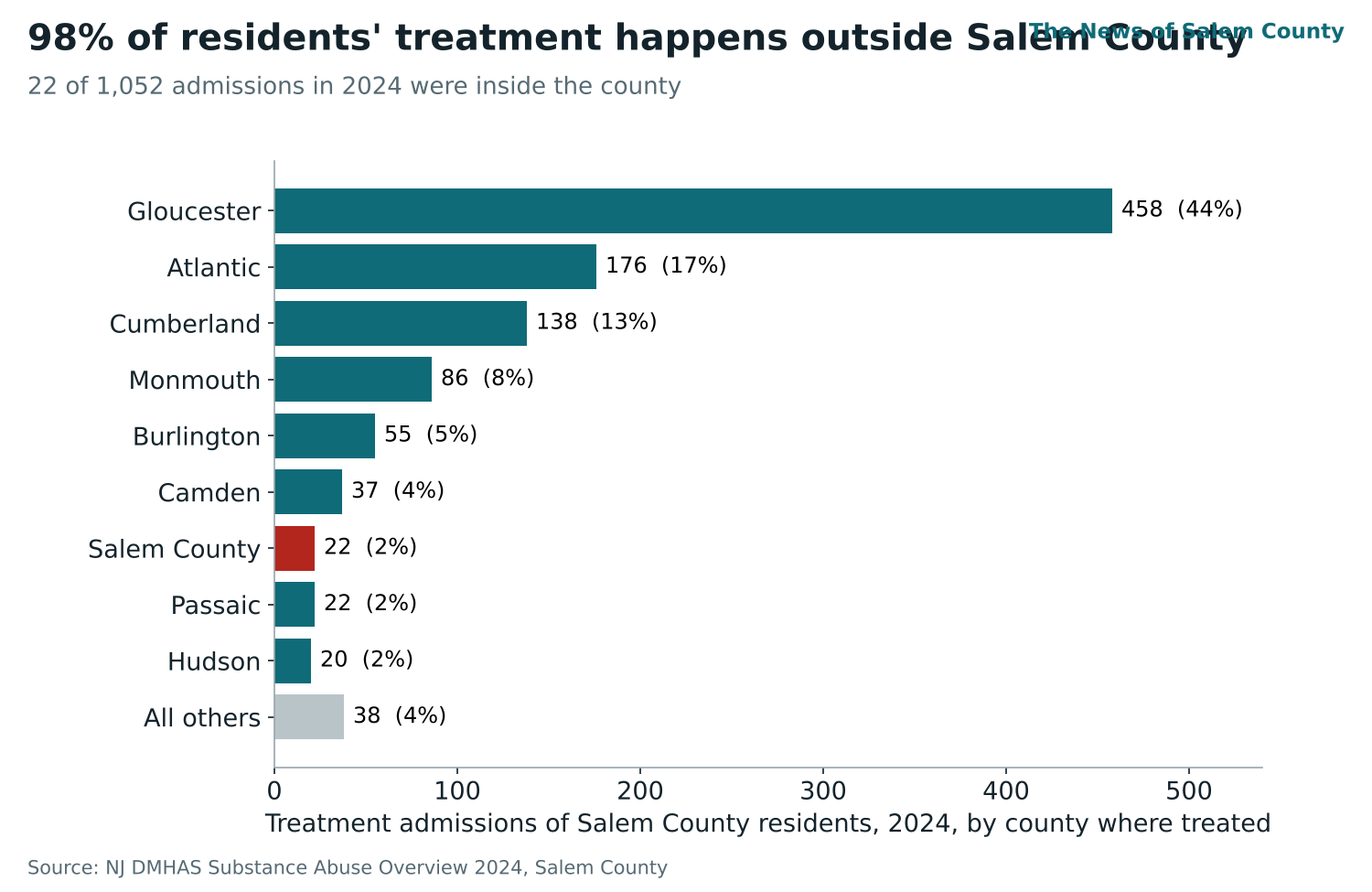
Source: N.J. Division of Mental Health and Addiction Services, Substance Abuse Overview 2024, Salem County.
The unspent money
The county reported $1,225,044.59 in unspent settlement money as of June 30, and it is projected to receive about $3 million more through 2038, according to the court-appointed administrator of the national settlements.
“Unspent funds are not an indication of inaction, but rather reflect the importance of identifying appropriate opportunities, addressing service gaps, and maximizing the impact of available resources,” the county’s release says.
It says spending decisions involve “a multi-agency decision-making process, with the county carefully reviewing funding requests,” and that the county works with its towns through the Municipal Alliance for the Prevention of Substance Use Disorder.
The Municipal Alliance is a separate program funded by the state Governor’s Council on Substance Use Disorder, not by settlement money. For the year that began July 1, the state set aside $94,385 for Salem County’s alliance program. The county awarded $24,385 of that to 10 local alliances covering 12 towns, in grants ranging from $1,843.67 to $3,953, according to a resolution the commissioners adopted Sept. 2. The amounts are the same as the year before.
The local alliances are in Alloway, Carneys Point and Penns Grove (one combined alliance), Elsinboro, Mannington, Oldmans, Pilesgrove and Woodstown (one combined alliance), Pittsgrove, Quinton, Salem City and Upper Pittsgrove.
Three towns are not part of any alliance: Pennsville, Elmer and Lower Alloways Creek. Elmer had the second-highest rate of substance use treatment admissions in the county in 2024, 41 per 1,000 residents, nearly five times the state rate, according to state data. Like every town in the county except Pennsville, Elmer receives no settlement money directly.
The release does not name the agencies or people who make those decisions, or say how a town, police department, school or treatment provider can request money. Fourteen of Salem County’s 15 towns are too small to receive settlement money directly, leaving the county in control of nearly all of it. The county’s reports to the state say it has no strategic plan for the money and did not seek public input in either of the last two years.
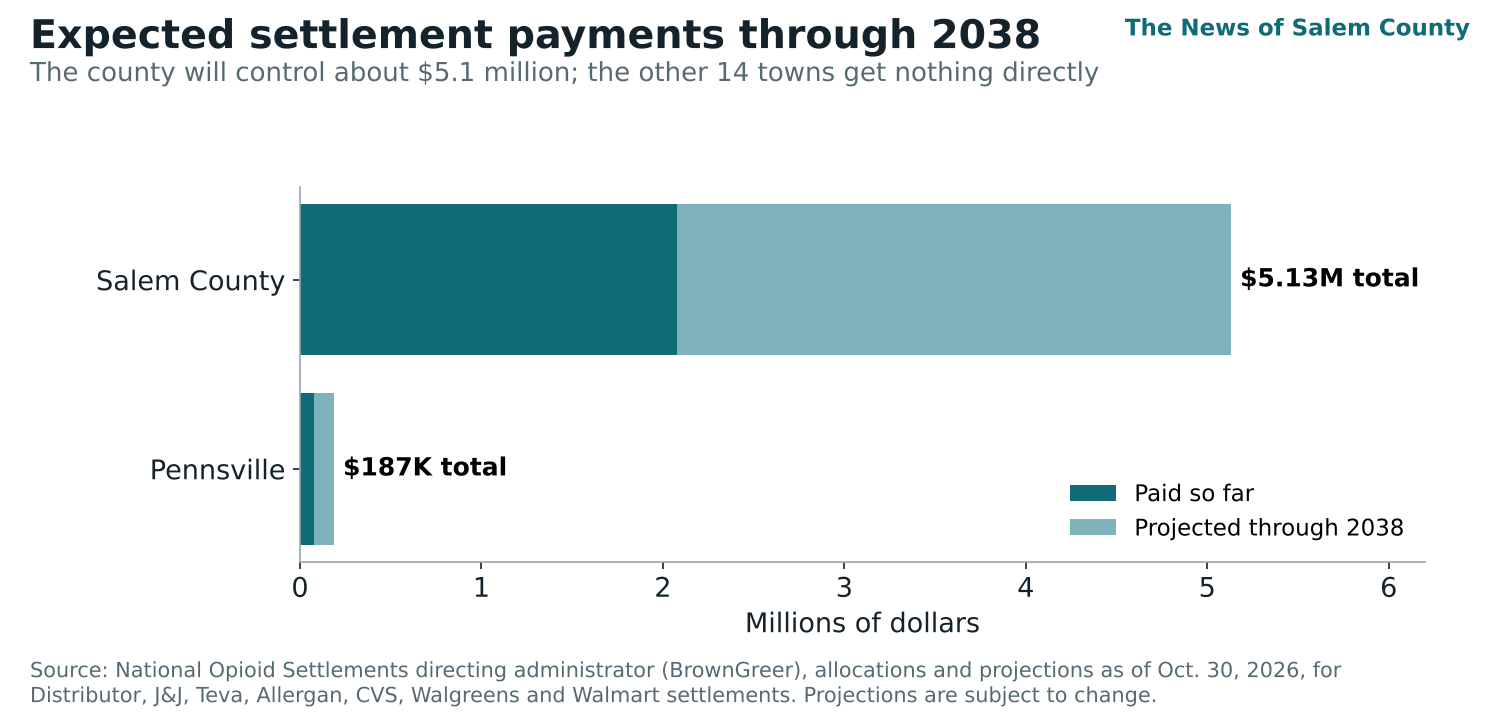
Source: National Opioid Settlements directing administrator (BrownGreer), New Jersey allocation data as of Oct. 30, 2026, for the Distributor, Johnson & Johnson, Teva, Allergan, CVS, Walgreens and Walmart settlements. Projections are preliminary and subject to change.
Still unanswered
The release does not address the questions The News of Salem County sent to Sieber, VanDover, and Pennington including:
- Which resolution authorized the purchase of the Green Street lot, what it cost and how it was paid for. Sieber’s figures for the purchase total $1,034,730, about $54,730 more than the $980,000 the commissioners authorized for the two Sharptown parcels.
- How charging $123,237 of the generator to the settlement fund serves opioid treatment, recovery or prevention. Sieber said in October the generator “is not a direct treatment or recovery service.”
- How much of the building’s space and time goes to substance use programs, and whether people seeking recovery help have private space or separate hours.
- Whether any salaries are paid from settlement funds. The county’s reports list administrative costs in one year but not the next two, while still describing salary costs.
- Whether the state approved using the federal CDBG-CV2 money and the settlement money for the purchase.
- Who serves on the county’s Opioid Settlement Advisory Committee.
- What the plan is for the $1.2 million balance.
The release directs residents to the state’s website for the county’s annual opioid settlement reports.