



What made the Lower Alloways Creek rabbit season worth the early start
The Lower Alloways Creek rabbit season opened on November 10, and it was a holiday that never appeared on any calendar. For generations the upland game season opened on November 10 unless the tenth fell on a Sunday, and in a township of dairy farms that meant the cows were milked in the dark so the day could belong to the dogs.
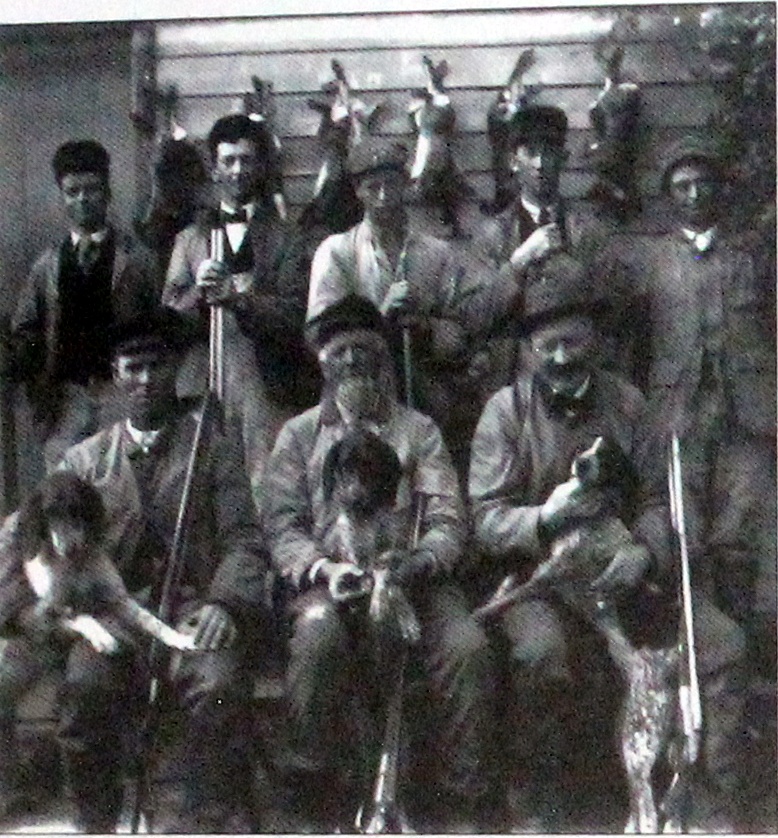
The photograph at the top of this page was taken at Alphonso Smick’s home near Maskell’s Mill in 1908, by William J. S. Bradway of Hancock’s Bridge. Eight men stand and sit on the porch steps with their guns and three dogs, and strung on the clapboards behind them, hung by the hind legs in a neat row, are twelve rabbits.
William B. Vanneman, who reprinted the picture in his Golden Days column under the headline “Rabbit Season Was A Time For Great Social Get-togethers,” did the arithmetic for his readers and found it wanting. “This picture, taken just before sitting down to the noon meal, shows 12 rabbits hung up in back of the gunners,” he wrote. “This would only be one and a half rabbits per gunner and they would want to give it another go in the afternoon so that each would have at least a pair to take home. There is nothing wrong with fried rabbit meat with nice brown gravy on sweet potatoes, for instance.”
That sentence is the whole point of the day. These were not trophies; they were dinner, and a man wanted two.
The men on the steps
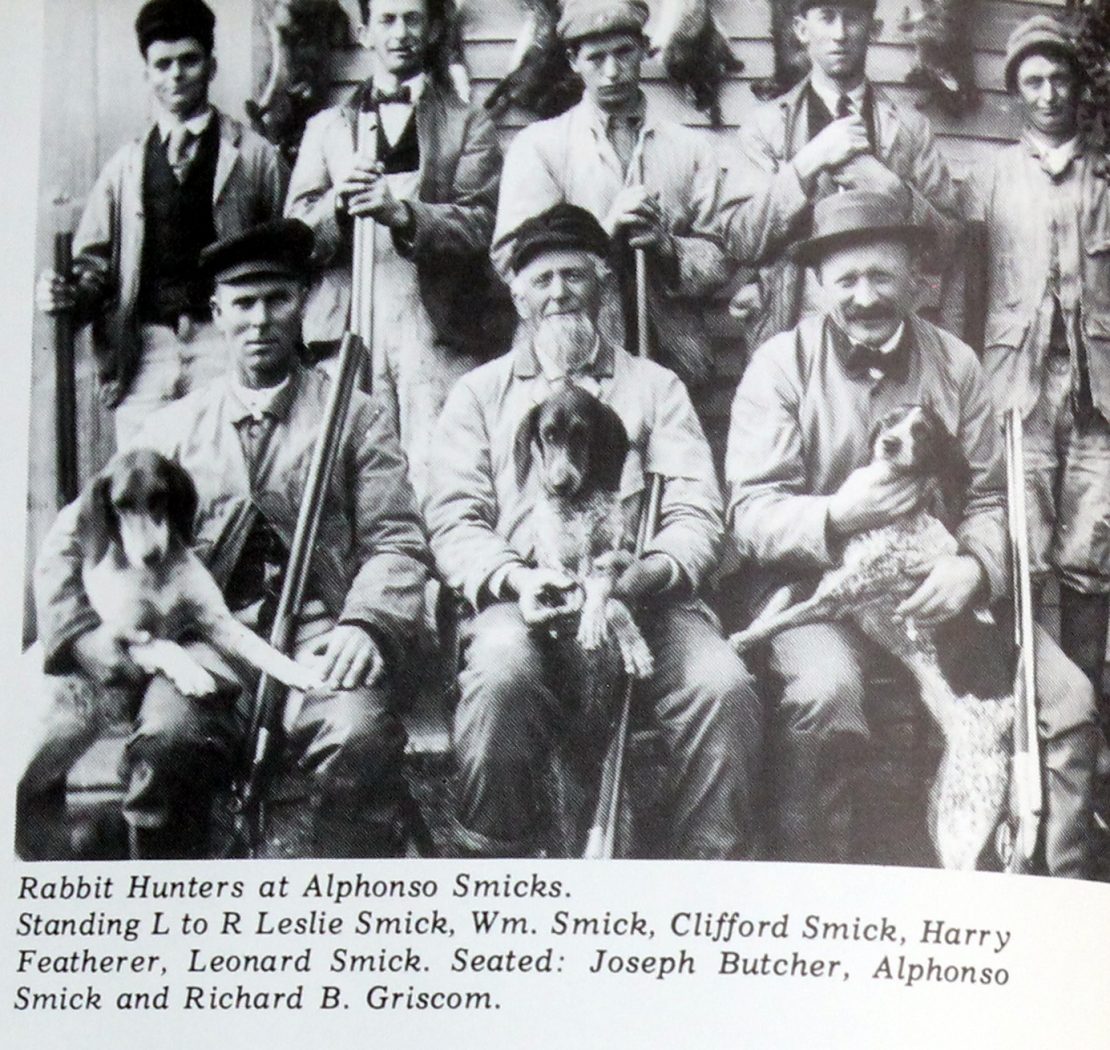
The caption that runs with the same photograph in How Dear to My Heart names them all. Standing, left to right, are Leslie Smick, William Smick, Clifford Smick, Harry Featherer and Leonard Smick. Seated are Joseph Butcher, Alphonso Smick and Richard B. Griscom. Alphonso is the patriarch in the center with the white beard, and the caption in Fond Recollections sums the group up as “Alphonso Smick, accompanied by his four sons and three friends.”
Vanneman knew most of them personally, and he wrote them up one by one, which is why a hunting photograph turns into a township census.
Alphonso Smick married Amy Hunt and they had nine children. Four of the sons are on the steps. The fifth, Howard, died in his nineteenth year. The daughters were Bessie, who married Joseph Keen; Minnie, who married Jonathan McPherson; Bella, who married Charles Finlaw; and Ethel, who married Loren Dilks. Loren died on October 9, 1973, and Ethel was still living in the home at Harmersville when Vanneman wrote, and gave him a great deal of the information about the family.
Clifford Smick, standing third from the left, was a painter by trade. Vanneman records what happened to him and does not soften it. “He had an unfortunate accident early in his life while hunting rabbits during a snowstorm,” he wrote. “Unknown to him, the barrel of his gun became partially plugged with snow, and when he fired it at a rabbit, the gun exploded, blowing the thumb off his left hand.” Clifford’s daughter Amy married Lewis Fogg, and their four children, Luke, John, Carl and Lois Fogg Beal, were all living in Lower Alloways Creek when the book was made.
Leonard Smick, at the right of the standing row, married Elsie Driscoll and they had twelve children. Both parents died in the influenza epidemic of 1919. Of their twelve, only the eldest, Raymond, had died by the time the family was written up; Herbert, Howard, Emma, Earl, Leonard Jr., Edna, Elsie, Alberta, Myrtle, Sarah and Naomi all survived them.
Joseph Butcher, seated at the left, was a Mannington farmer and a close family friend. He died of a heart attack at eighty-one, in his nephew’s yard, while getting ready for a day’s fishing on Delaware Bay. Richard B. Griscom, seated at the right, was the perennial bachelor of the group, a close friend of Alphonso and a frequent guest at the Smicks’, and he was, Vanneman notes, the man frequently called upon to make a fourth at bridge.
There is one more thing in the picture that nobody could answer. “Three pretty nice-looking children are shown on the front row,” Vanneman wrote. “I tried to find out their names but no one seemed to remember them.” They are still unnamed, a hundred and eighteen years later.
Why Lower Alloways Creek
Alphonso Smick had come from Mannington Township, and several of the guests that morning were former neighbors from up that way, which prompted Vanneman to think about ground rather than marksmanship. “I imagine there were more rabbits in L. A. Creek because of better cover in the low spots,” he wrote. “In Mannington the land is generally a few feet higher and farmed pretty close to the line fences.”
It is as neat an explanation of local game populations as you will find; a rabbit needs somewhere to hide, and a field farmed tight to its own fencerows does not give him one.
Milking in the dark
The second half of the chapter belongs to the book’s editor, David A. Fogg, writing about his own boyhood on the family’s Canton dairy farm, and it is the passage that fixes the date.
“As a boy, I remember how I looked forward to the first day of rabbit season,” he wrote. “The season for upland game always started on November 10, unless it was a Sunday. My brothers and I had the cows milked, fed, and all other work pertaining to our Canton dairy farm completed well before daylight. We started hunting when you could barely see one another.”
That last clause explains what happened next. “Several years later the game laws were changed, making it illegal to start hunting before 9 a.m. on the first day of the season. One reason for the change was to make sure hunters identified their quarry, and did not shoot each other in the early dawn.”
The hunting itself was done on neighbors’ ground with neighbors’ dogs. “My dad and my Uncle John always kept good rabbit hounds,” Fogg wrote, and the gang assembled on the farm then belonging to Theodore Smith, at the end of Silver Lake Road on the right, which by the time of writing had become the headquarters of a hunting club.
Mike
The best story in the chapter is about a dog nobody wanted to go back for.
The morning had slowed and the group was moving out of the area, but one of the old dogs stayed behind, yelping now and then on what everyone else had written off as a cold trail. He was half a mile off, in the spot the locals called Wolf Pit Point.
“Since I was the youngest, about 13 at the time, I was ordered to go and bring him back to the group,” Fogg wrote. “I obeyed ‘under protest,’ growling about this dumb old dog all the way. I finally persuaded Mike to come along with me, and while walking toward the group, Mike chased up a rooster pheasant. Luck was with me, and when I rejoined the group, I had bagged the only rooster pheasant. Mike wasn’t so dumb after all.”
There is a parenthesis in that passage worth keeping. “I believe we hunted with at least ten dogs named Mike during my lifetime.”
Eighteen rabbits before noon
The biggest day he records came in about 1942, on Smith Flanegan’s farm, later owned by Mrs. Waddington B. Ridgway. Flanegan’s daughter Mary had married Fogg’s eldest brother Albert, so this was family ground in the way most ground in this township is family ground. Fogg hunted it that opening day with Ralph Reeves and his brother Lewis, and from nine in the morning until noon the three of them took eighteen rabbits and one pheasant.
The pheasants had a standing appointment. “We often had pheasant at Thanksgiving along with turkey,” he wrote. “Thanksgiving morning was a great morning to hunt. Somehow the dogs knew, too, and with their mournful howls and pitiful eyes, they begged to be included.”
The skins, and the little jingle
Vanneman spends a paragraph on what became of the rabbit after dinner, and it is a small lesson in how a country economy tried and failed to dress itself up. “Even by calling rabbit skins ‘Lapin,’ I don’t believe they ever really became very popular,” he wrote, “although I do seem to recall seeing a few coats and other accessories that resembled rabbit fur.” What did take was humbler. “The little soft tail of white fur which gave them the name of cotton tails made a toy that the kids liked to play with.”
He opened the whole column by wondering whether anyone still remembered the lullaby that went with it:
Bye Baby Bunting! Daddy's gone a-hunting To get a little rabbit skin To wrap my Baby Bunting in
The last beagles
Fogg closes with a litter he raised in 1964 and 1965, giving one pup to his friend Paul Morris, who had married Rufus Cuff’s daughter Anna, two to his brother Edward, and keeping two.
“My, what fun we had when Edward and I hunted together,” he wrote. “It is often most enjoyable to watch good dogs work a rabbit and listen to them bark and yelp. Sometimes I think the rabbit enjoyed the challenge, too.”
And then the line that ends the rabbit hunting in that book for good: “These wonderful dogs did not live long, for we lived in a mosquito-infested area, and it was before methods to control heart worms were perfected.”
What we would like to know
The three children on the front row of the 1908 photograph were already unidentifiable when Vanneman went looking for their names, and he was asking people who had known the Smicks. We would like to try again anyway. If a face on those steps is in your family album, or if anyone ever told you who the children were, we want to hear it.
We would also like to hear from anyone who still marks the tenth. The state sets its own dates now, and they move; the old fixed November 10, holding every year unless it landed on a Sunday, belongs to the generation that milked in the dark to get out the door.