


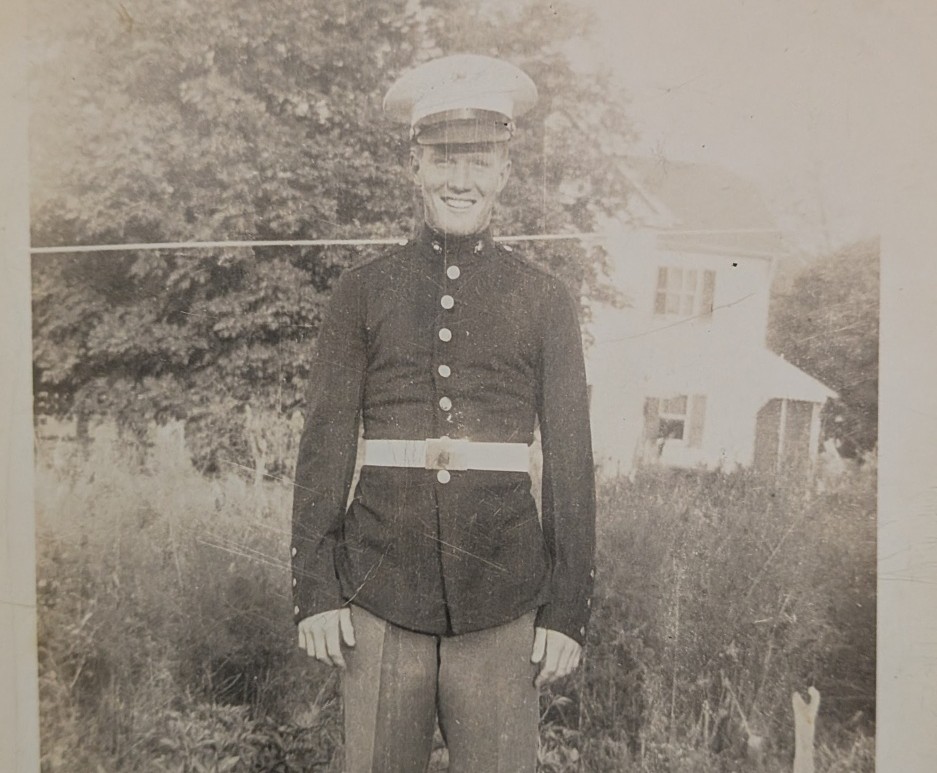

A Grandfather’s Purple Heart: Remembering George “Shorty” Remster
ALLOWAY – Every August 7th, National Purple Heart Day asks us to pause for the men and women who carried the physical cost of American war home with them. For my family, that day has a name attached to it: my grandfather, George “Shorty” Linwood Remster.
Shorty grew up right here in Alloway and went to Woodstown High School. In 1942, at seventeen years old, he made a decision that would define the rest of his life — he left Woodstown High School before finishing his senior year to enlist in the United States Marine Corps.
He was assigned to the 1st Marine Division and shipped out to the Pacific Theater, where he served as an assistant machine gunner through some of the war’s most brutal fighting: Guadalcanal, New Caledonia, and Guam.
It was on the beaches of Guam that his war nearly ended. A Japanese grenade detonated on his arm, and he found himself pinned down in a foxhole overnight — alongside the bodies of the men who had fought beside him. He recalled, decades later, lying still and watching Japanese soldiers move through his fallen friends searching their mouths for gold fillings, playing dead himself to survive the night. He used to say, half-joking, that he was fortunate to have had good teeth.
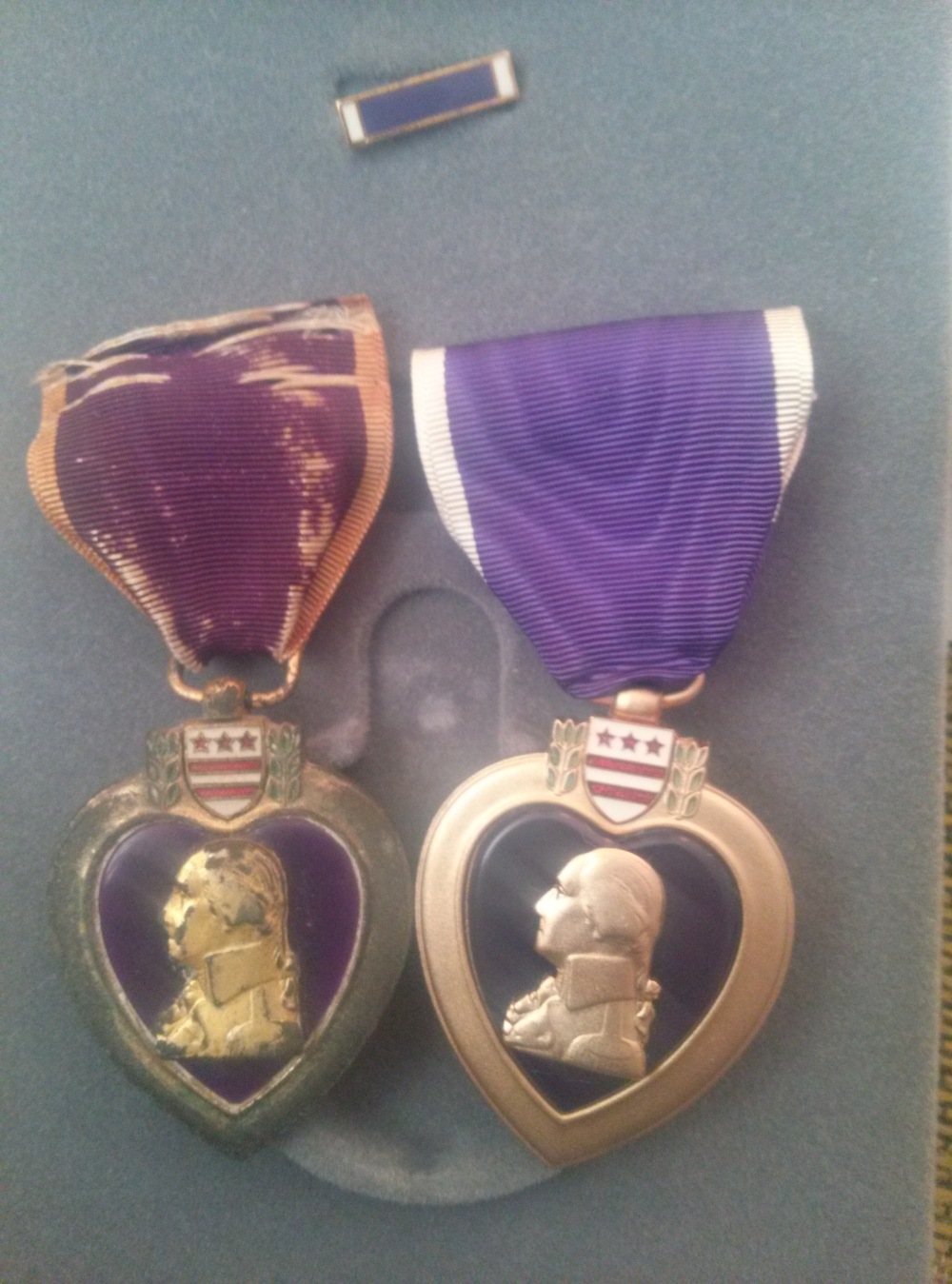
U.S. Navy medics found him the following morning and evacuated him to a hospital aboard a U.S. Navy ship. It was there, aboard that vessel, that he was formally presented with the Purple Heart — the medal awarded to service members wounded or killed in the line of duty.
But in the chaos of a wounded soldier’s transfer between ships and hospitals, the medal didn’t stay with him. He’d left it in his bag, and by the time he went to retrieve it, it was gone.
Not long after, Admiral Chester W. Nimitz — the commander who oversaw the entire Pacific Fleet, and who would be promoted to the Navy’s newly created five-star rank of Fleet Admiral that December — came through the line of wounded Marines to speak with the men who’d fought at Guam. My grandfather wanted to show him the medal he’d just been awarded. He couldn’t find it.
Nimitz didn’t miss a beat. “At ease, Marine,” he told him — and then reached up, unpinned his own Purple Heart, slightly corroded from his own service, from his own chest, and pinned it onto my grandfather’s uniform.
I don’t know how many other stories like that exist from that war. I only know this one, because it’s mine — passed down through my family, carried the way these stories are: imperfectly, but with the weight still intact.
For years, both medals stayed together in my family — his new one given after his death, and the one Admiral Nimitz gave up that day on a ship off Guam. They don’t anymore. One of them was sold years later, during the worst of my family’s struggle with a different disease. It’s not a detail I share lightly, but it feels dishonest to leave out. War isn’t the only thing that takes something irreplaceable from a family, and addiction has its own way of reaching back through generations and taking what survived everything else.
My grandfather’s story, and what’s happened to what he carried home from it, are both part of the same truth: some wounds show up on a beach, and some show up decades later, in a house down the street from where you grew up. Both deserve to be spoken about honestly.
On this Purple Heart Day, I’m thinking about him. And I’m thinking about how many other families in Salem County are carrying stories just like this one — some with the medals still in hand, some without, but all of them worth telling.
If your family has one of those stories, I hope you’re telling it today too.
Nice memories! My dad was from Pennsville and he and his brothers joined together, as soon as the war broke out. They were separated before they went to war. Dad went to Normandy and Africa, and Germany. He was blown out of a foxhole and moaned when the French were getting ready to bury him. He was in 6 different hospitals before they shipped him home to a hospital in Atlantic City. He waited for 61 years to get his Purple Heart. Senator Graham from SC was instrumental in getting it for him, with the help of my sister and my mother. He said he didn’t want it because he had friends who died in the war. But he deserved it. He knew your grandfather since we lived in Alloway for 14 years. He knew all your great uncles too. Thanks for sharing.
Thank you for sharing about your father. They sure don’t make ’em like they used to. It wasn’t a question of if but when some of the Remster Brothers could enlist and begin fighting for their country (nor can I forget Aunt Edna who served in WWII as well). I am certain your dad and his brothers all were the same way. Would give the shirt off their back and begin unlacing their sneakers until you told them the shirt was just fine. Many thanks for the kind words.