


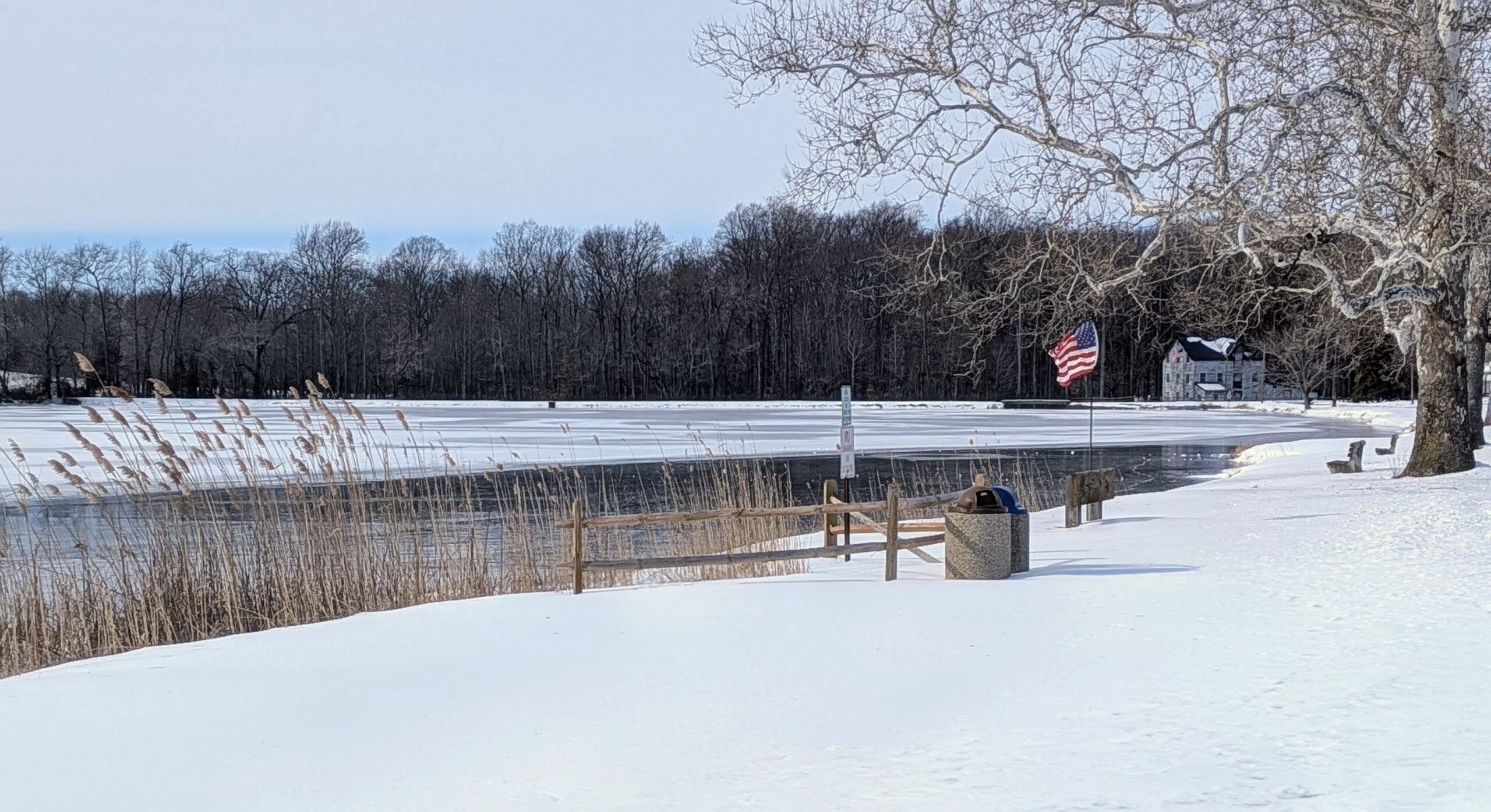
The history of Fox’s Mill and Daretown Lake in Upper Pittsgrove Twp.
The original spot of Joseph Elwell’s grist mill was located on the northwestern banks of Daretown Lake’s original site on the western side of Daretown Road. Elwell’s first mill was close to where Fox Mill Road meets Daretown Road. According to the Greater Elmer Area Historical Society, Elwell built the mill and began operations in 1731.
After countless hours of going through old records, the first reference to the current location of the mill was, arguably, determined from a 1772 map which noted the location of “Elwell’s Old Mill.” This implied that there was a new mill that at the time Elwell’s son operated at the current location of Fox’s Mill. However, the other earliest source that referenced the new location of Fox’s Mill was in 1825. So, we will just agree that today’s Fox’s Mill was built between 1772 and 1825.

Fox’s Mill with a reproduced grist mill stone that sits in front of it.
The grist mill was used for turning wheat in flour and corn into cornmeal by creating “raceways” (man made canals) which utilized and increased the flow of the water powering the grist mill via turning the water wheel. Joseph Elwell’s will in 1740 left the operation to his son Jacob Elwell. Jacob operated the mill and left it to his children Samuel and Johnathon. The two brothers continued the business until 1825 when they both left their share to their children. Samuel Elwell’s half went to Mary Elwell and another family member whose share was obtained by Mary and her husband Isaac Johnson. Jonathan Elwell’s share was left to his heirs via his estate which eventually passed through an uncle of Mary Elwell and purchased by Samuel Dare (the “town’s” namesake).
Fox’s Mill in the early 1900’s. Notice the square-shaped addition in the front left but just a lean-to on its side unlike today’s walled in area.

Johnson and Dare were the 4th generation of owners in 1825. According to old stories, it is believed that the first recorded shipment of the mill’s products were sent via the Cohansey River down to Bridgeton and eventually down the Maurice River to Cape May.
The Mechanization of Fox’s Mill during the 1850’s
In 1850, Isaac Johnson left his portion to his son Benjamin Thompson and Dare’s portion went to his son who in turn sold it to a gentleman with the last name of Foster. The grist mill was known at the time as Foster’s Mill. During the 1850’s, the water wheel became obsolete as the mill was mechanized with a steam engine. It was placed beside a newly built large brick chimney in the mill’s basement which is believed to still be there according to a source in 1991.
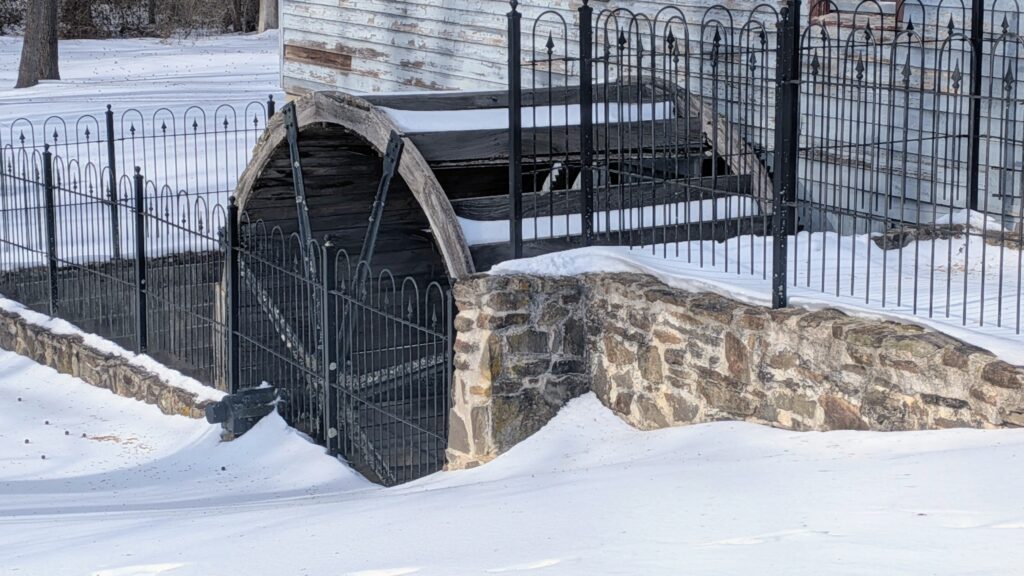
A reproduction of the old water wheel used to turn the grist stones
The mill changed owners to George Avis in 1868 (who operated a mill on the next lake down the tributary in Pilesgrove, known as Avis Mil). It was during his ownership that it is to be said that the new location of the dam was created and Daretown Lake expanded to its current size and position today.
George Avis left the mill to his son and, in 1886, two brothers (Charles and Thomas Fox) purchased the mill and somehow the name of Fox’s Mill was given and still is known as that today. The Fox brothers operated the mill until 1912. Thomas Fox also had a mill on Willow Grove lake in the late 1800’s.
In the early 1900’s an electric motor was installed to power the mill according to Ed Hutchinson via Jay Williams’ research. Eventually, the industrial revolution drastically increased the supply of flour and cornmeal and Fox’s Mill soon just became a storage building for farm equipment.
The Devastating Flood of 1940 results in Fox’s Mill Preservation
In the year 1940, a flood that drastically impacted the eastern and middle portions of Salem County nearly destroyed the mill and took out the dam causing the lake to drain. Completed in 1947, the new dam resulted in the lake’s current size and surface area.
On the large brick surrounded plaque aside the lake states the efforts were “sponsored by First County Bank & Trust Co., and George B. Marshall; trustees of the estate of Frank H. Stewart.” Stewart also owned Fox’s Mill and in his will it was given to Upper Pittsgrove Township with the stipulation that it never to be sold nor used for anything other than a beautiful reminder of the area’s rich historical significance.

Plaque that sits aside the Daretown Lake in recognition of those who sought to preserve the mill and lake. It states: “Daretown Lake acquired with funds provided under the Will of Frank H. Stewart and donated to the Township of Upper Pittsgrove June 22, 1956. This project sponsored by First County Bank & Trust Co., and George B. Marshall. Trustees of the Estate of Frank H. Stewart. Deceased.”
Decades later, a well-known Daretown resident by the name of Jay Williams had re-created the water wheel and it was placed beside the mil (pictured).. His efforts also resulted in the creation of the runner stone of the grist mill which is currently in front of the mill.
Jay WIlliams had passed away in 2008 but his restoration efforts were completed before his death. However, his along with many other local volunteers’ impact on the mill and the public’s knowledge of Daretown’s rich history will continue through future generations.
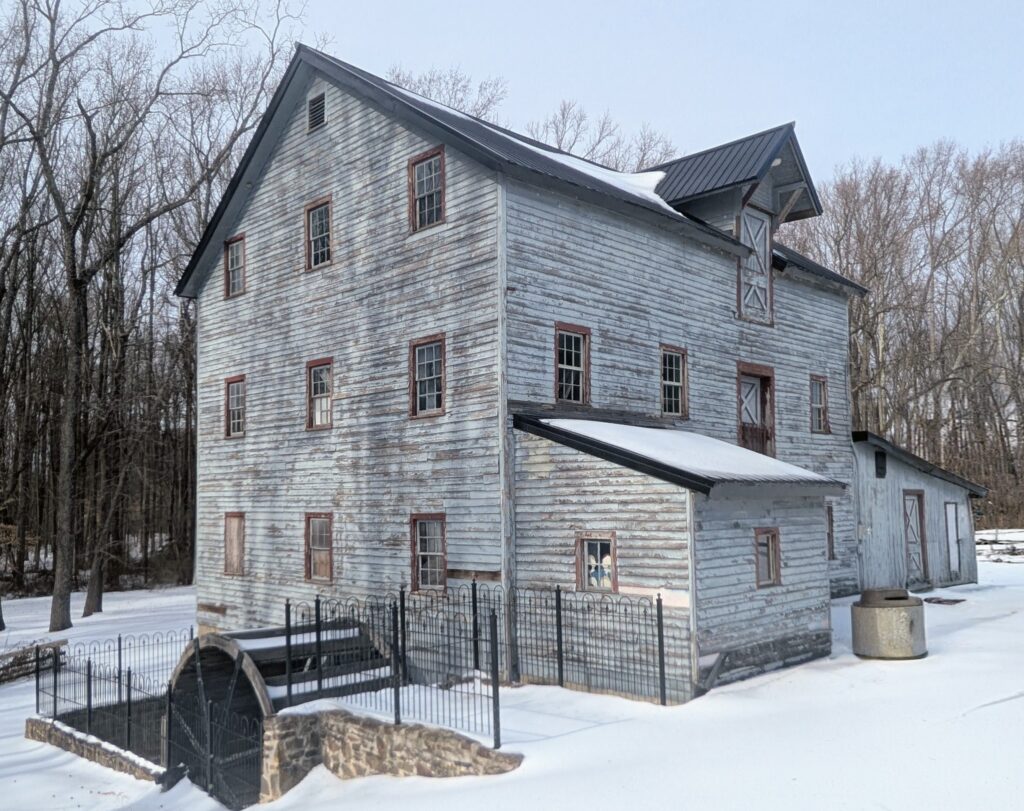
The old Fox’s Mill restored sitting alone on a cold winter’s day.
After roughly ten generations of different owners, the mill ceased operations, but it is cherished by residents and visitors from all over the country. It stands as a representation of the rich and impactful history of Daretown.
The story doesn’t end there. Flocks of people still make their way to the area today. Not for flour or cornmeal though! They come for the bountiful natural pleasures.
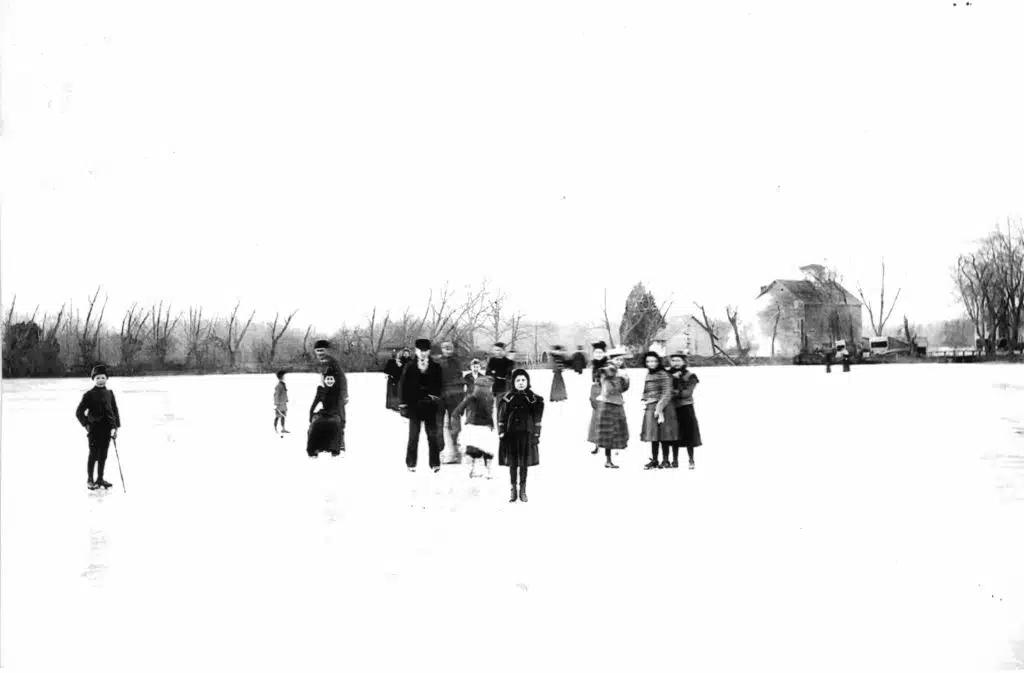
Members of the local Daretown community ice skating in the early 1900’s on Daretown Lake during winter months.
Daretown Lake’s Abundant Natural Resources
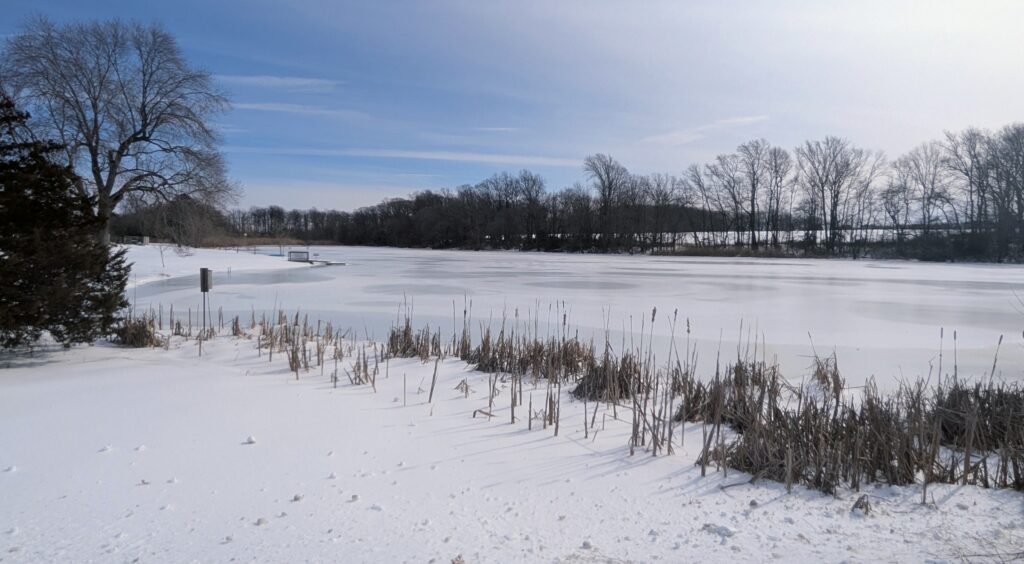
The 26 acre Daretown Lake is a bird watchers haven as it is known as a great roosting area for great blue heron which are seen swooping down along the lake catching fish, great horned & screech owls can be heard calling in the evening/nights, and songbirds fill the air throughout the warmer seasons. Also, just west of the lake along the trail near the spill-over dam are old thick forests filled with hairy, downy and red-bellied woodpeckers along with fresh tracks of the many nocturnal animals including deer, raccoon, skunks, rabbits, and foxes.

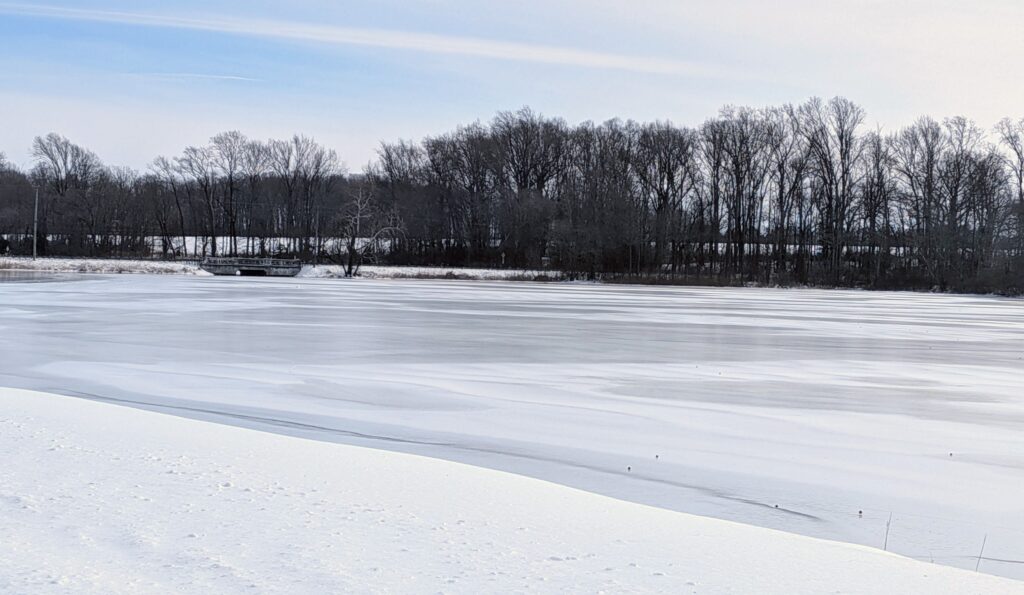
Daretown Lake frozen during the winter months. This is the newer side of the lake closest to the mill.
Although there may be others, anglers can expect to find a variety of fish including largemouth bass, white and bluegill crappie, and yellow/white perch in the lake. Turtles are abundant also as you can see the plethora of heads breaking the still water’s surface during warmer months. Also, the multitude of acorns and nuts in the fall attract squirrels, white tail deer and many wild turkeys. It is picturesque with its abundant natural resources that make up South Jersey’s freshwater wetlands.
Daretown Lake is just one of the dozens of Salem County’s natural treasures which is steeped in centuries of rich, local history. Be sure to place it atop your list of local places to visit.
Sources:
- – https://upperpittsgrovenj.org/recreation/
- – https://www.lake-link.com/new-jersey-lakes/salem/daretown-lake/325192/
- – Special thanks to Bonny Beth Elwell of Greater Elmer Area Historical Society