


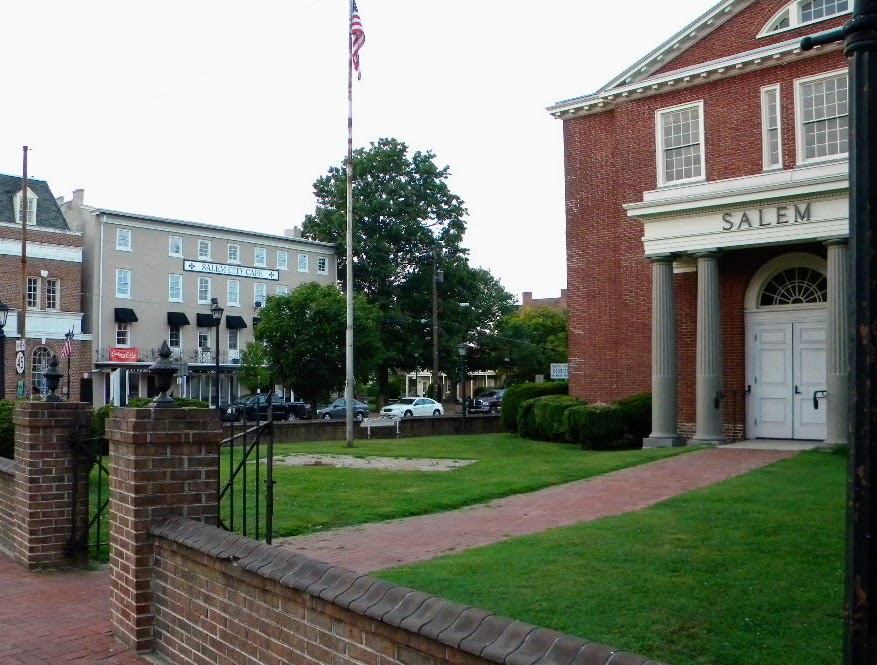

Every Salem County kid grows up knowing the story. In 1820, an old colonel named Robert Gibbon Johnson climbed the steps of the Salem County Courthouse, pulled a handful of bright red “love apples” from his coat, and ate them in front of a horrified crowd who fully expected him to drop dead. He didn’t. And with that one bite, Salem County supposedly launched America’s tomato industry and earned New Jersey its “Garden State” reputation.
It’s a great story. Salem celebrated it for decades with reenactments on the courthouse steps, eventually formalized into the Salem Tomato Festival, which ran from 1989 to 2022. There’s just one problem: the deeper you dig, the less anyone seems to have actually known.
THE MAN WHO GAVE US THE LEGEND
The Johnson tomato story doesn’t come from an 1820 newspaper, a courthouse record, or a diary. It comes from one man: Joseph S. Sickler, Salem’s postmaster and the county’s most devoted amateur historian, who first put the story into print in his 1937 book, “The History of Salem County.” No footnotes. No contemporary source. Just Sickler’s word.
THE QUOTE THAT WASN’T THERE
By 1949, in his book “The Old Houses of Salem County,” Sickler wasn’t just describing the scene anymore — he was putting words directly in Colonel Johnson’s mouth, rendered as if someone had been standing there with a notepad: “Here, I’ll show you dumb, blankety-blank fools these things are good to eat. What are you afraid of? Being poisoned? Well I’m not, and I’ll show you I’m not.”
There was no one left alive in 1949 who heard Robert Gibbon Johnson speak in 1820. Sickler was writing dialogue, not transcribing it. And he didn’t stop at his own book — by his own account, he told the story to author Harry Emerson Wildes, who used it in his 1940 book “The Delaware.” Wildes’ version was picked up by pop-historian Stewart Holbrook for his 1946 bestseller “Lost Men of American History,” where the story jumped the rails entirely: Holbrook added a crowd of 2,000 spectators gathered to watch Johnson die. The 1820 U.S. Census puts the entire town of Salem’s population at 1,217. All of Salem County had 14,022 residents. Two thousand people most likely did not ride horses and buggies to the courthouse steps that day.
THE PEOPLE WHO SHOULD HAVE CHECKED
What’s most striking about this legend isn’t that it grew — it’s how many people had a direct chance to stop it, and didn’t.
When CBS Radio decided to dramatize the story for its program “You Are There” in January 1949, the network’s own researcher, William Chew, tried to run it down first. What he found was thin: “Salemites in general seemed to have heard it, but couldn’t say just where.” That should have been the end of it. Instead, CBS aired the dramatization anyway, hiring Sickler himself as “historical consultant” — a broadcast that added a fainting woman in the crowd and a firemen’s band that switched from a funeral dirge to a celebration march the moment Johnson didn’t drop dead. The timing is worth noting: Sickler had been removed from his job as Salem’s postmaster in 1948, reportedly under suspicion of misappropriated funds, just before that broadcast aired. Historian Andrew F. Smith, whose 2001 book “The Tomato in America” remains the most rigorous investigation of this legend, has written that Sickler later admitted the CBS broadcast was “a plug for our Salem and for me.”
CBS wasn’t the only one who didn’t check. Writer Francis Coulter wrote directly to the Salem County Historical Society asking about the incident and was told plainly that there was no factual evidence it had happened. He published the legend anyway, in a piece for Horticulture magazine. Author Robert Hendrickson picked it up next for his book “Lewd Food,” claiming he’d tried to verify it against primary sources but was blocked because “a fire in the local newspaper office had destroyed all records of the period.” There was no such fire. Some 1820 Salem newspapers are missing, but others survived — including a copy of the Salem Messenger dated September 27, 1820, one day after Hendrickson’s own claimed date for the event, along with subsequent issues. None of them mention any tomato-eating demonstration. According to Smith, no reference to a tomato in Salem has been found in any primary source before the mid-1830s — over a decade after Johnson supposedly ate one in front of a crowd.
The legend kept climbing anyway. In 1988, a Philadelphia television station’s coverage of Salem’s reenactment was picked up by ABC’s Good Morning America, which reported as fact that Johnson had eaten “the first tomato in America.” At every stage of this chain — CBS, Horticulture, “Lewd Food,” Good Morning America — someone could have checked. At least two of them did check, were told there was nothing there, and ran the story anyway.
THE CASPER PROBLEM
To his credit, Sickler didn’t just invent a source out of thin air — he named one. In 1949, he revealed that his version came from William Casper, a respected Salem auctioneer, who Sickler said had heard it from his own grandfather: Sheriff Thomas J. Casper, who Sickler claimed had personally witnessed the 1820 event.
Thomas Casper is a real, findable person — Salem County’s own sheriff’s roster confirms a Thomas Casper served as sheriff from 1837 to 1840 (older typeset records render it “Thomas I. Casper,” almost certainly an I/J transcription of the same name). So the man existed. Whether he witnessed anything in 1820, or told his grandson what Sickler says he did, is a separate question — and this is where Smith’s research raises a real problem.
Thomas Casper had a son as well as a grandson: Charles Casper, William’s uncle. Charles wasn’t a peripheral figure. He was a tinsmith who began canning fruit in Salem in 1853, later became part-owner of a successful Salem canning factory, and stayed in the packing industry until he retired around the turn of the century — meaning he spent his entire working life in exactly the industry this legend claims to explain the origin of. In 1906, he wrote a four-page paper for the Salem County Historical Society on the history of canning in Salem. In it, he gave a completely different account of how the crop arrived: “the tomato was brought to Salem, New Jersey, in 1829 by some ladies from Philadelphia.” No Johnson. No courthouse. No mention of his own father witnessing anything at all.
Smith’s question is the obvious one: why would Thomas Casper tell his grandson a dramatic eyewitness story about Colonel Johnson, but never mention it to his own son — a man who spent his career in Salem’s canning industry and would have had every reason to know, and repeat, a good origin story if one existed? It doesn’t prove Sickler’s version is false. But it’s hard to square.
THE MAN BEHIND THE MYTH — AND THE FULL RECORD
Strip away the legend, and Robert Gibbon Johnson doesn’t need it to be remembered. Born in 1771, he was a Princeton graduate who lived through British raids on Salem as a boy and later served under President Washington during the Whiskey Rebellion. He was a serious agriculturalist and an even more serious writer — in 1839 he published his own history of the county’s founding, telling the story of Fenwick’s Colony from John Fenwick’s perspective rather than the Philadelphia-centric version favored across the river. In 1845, he helped found the New Jersey Historical Society and served as its first vice president. He was an active member of the Salem County Agricultural Society, and Salem’s newspapers mentioned him often enough that his life is unusually well documented for the era — biographies of him appeared in several 19th-century works, and his own granddaughter later compiled a full genealogy of the Johnson family.
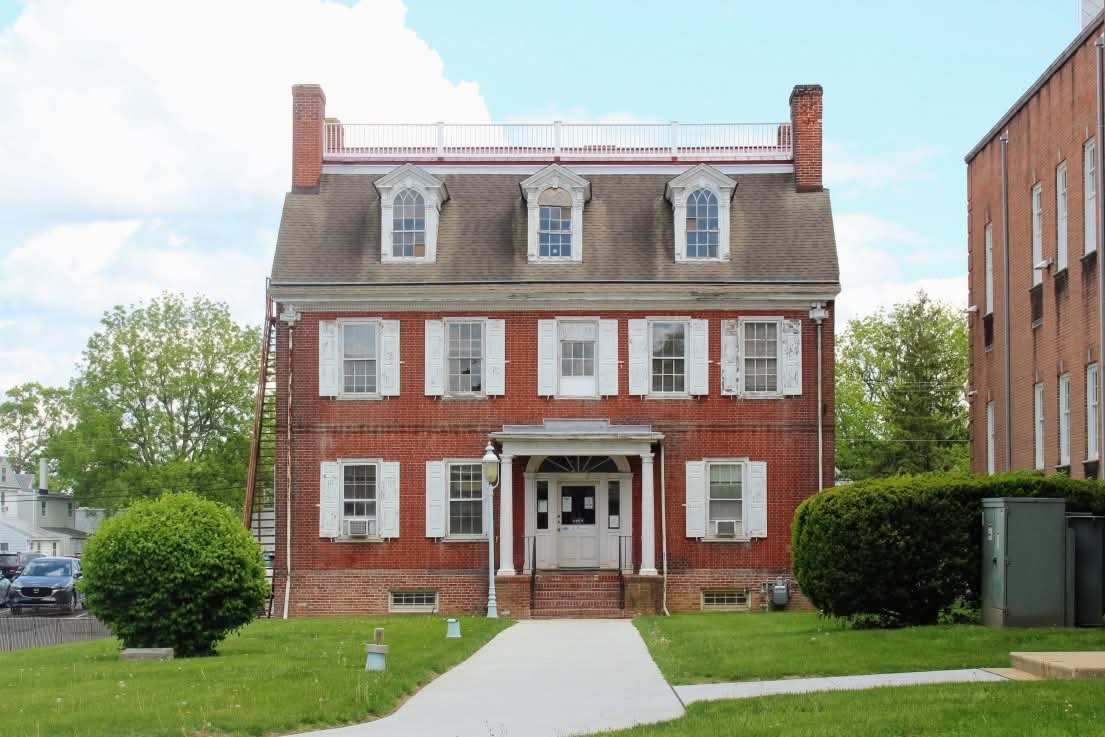
Colonel Robert Gibbon Johnson House on Market Street next to the First Presbyterian Church and between the Old Salem County Courthouse.
And in all of it — including his own 1839 history of Salem, which chronologically covers the very period the legend is set in — no 19th-century record has ever surfaced crediting Robert Gibbon Johnson with introducing the tomato to Salem. Not from him. Not from anyone who knew him.
The full record also includes something the tomato legend has never mentioned: Johnson was a slaveholder. According to the Salem County Cultural & Heritage Commission’s own “7 Steps to Freedom” history series, a woman named Amy Hester Reckless was enslaved first by Johnson’s mother, Jane Gibbon Johnson, and then inherited by Robert Gibbon Johnson himself. Reckless fled to Philadelphia after what a contemporary 1826 letter, held in the Salem County Historical Society’s archives, described as “severe usage” by Johnson’s second wife, Julianna Zantzinger. Johnson sought her return; she refused. In Philadelphia, Reckless worked with the Female Anti-Slavery Society, and after Johnson’s death in 1850, she returned to Salem — living just up the street from his home, Johnson Hall — where she continued that work alongside fellow abolitionist Abigail Goodwin, helping freedom seekers on what local history documents as the Underground Railroad.
Reckless built her own legacy of courage in the very town Johnson called home, and it deserves to be told alongside his. Salem‘s own Tomato Festival was reportedly put on hold once this history came fully to light, according to Salem County Historical Society director Rich Guido.
None of this erases what Johnson accomplished as a historian, agriculturalist, and public servant — those things happened, and they’re documented independently of the tomato story. But a complete picture of the man Salem County has spent nearly two centuries mythologizing has to include the people his position in that history touched, including a woman who, unlike Johnson, had to fight for her own freedom before she could write any part of her own story.
WHY THE LEGEND STILL MATTERS
So did it happen? Honestly, we may never know — and the more of the record you read, the less it looks like it happened the way Salem County has celebrated it for decades. The newspapers that survived from the fall of 1820 don’t mention it. The one direct descendant with the most reason to know the family’s own canning history told a completely different story and never mentioned Johnson at all. And nearly everyone who carried the legend to a national audience — CBS, a horticulture magazine, a national bestseller, Good Morning America — had a chance to check it against the record and either didn’t, or did and published it anyway.
What is certain is this: tomato canning did become the backbone of Salem County’s economy in the decades that followed, feeding processing giants that turned South Jersey into a name in kitchens across the country. Somewhere along the way, this county needed a founding story for that industry, and one man — using a source that may not have held up even to his own family — gave it one. Whether Colonel Johnson ever stood on those courthouse steps, Salem County’s tomato identity is real regardless of how it started.
That bigger story — how the tomato helped build Salem City into an industrial center, and what happened after that industry left — is one The News of Salem County will be telling soon.