



The county’s economic development director says the designation is a financial tool, not a way around local zoning, as Treasury review nears.
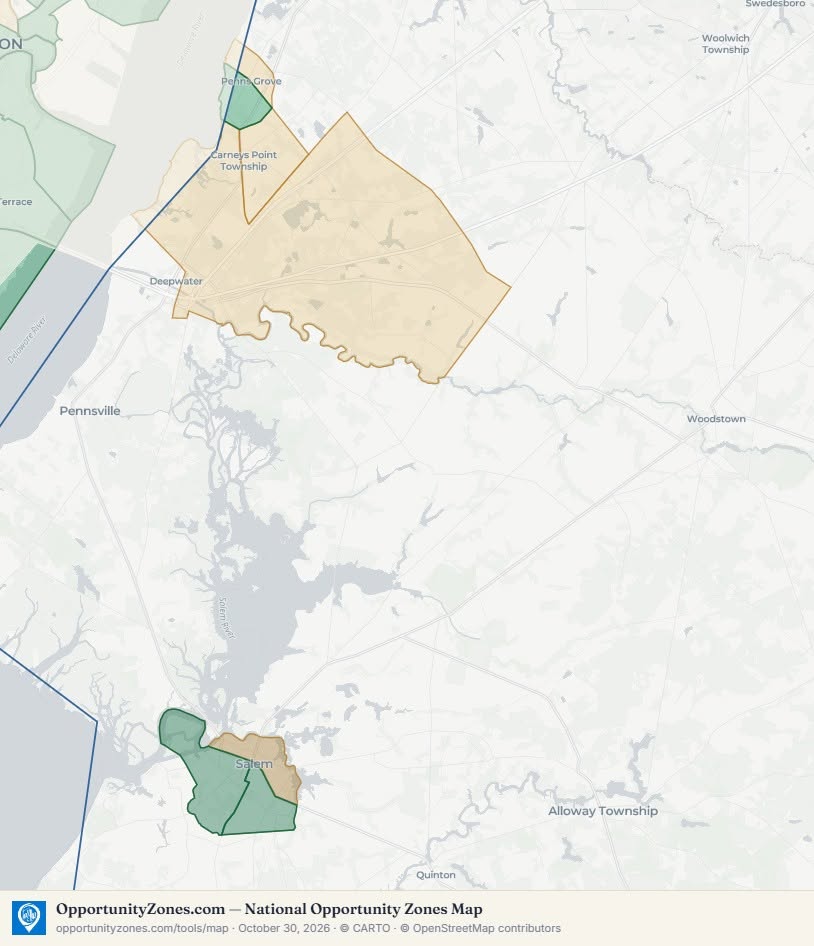
Three census tracts in Salem County, two in Salem City and one in Penns Grove are among the tracts New Jersey has nominated for the next round of the federal Opportunity Zone program, county economic development officials said this week.
Salem County Economic Development Director Sean Sepsey said the nominations could make the two communities “magnets” for private investment, but he also wanted to clear up a point he has been hearing questions about: Opportunity Zones do not let developers get around local zoning or planning.
What was nominated
The nominated tracts are:
- Salem City, Census Tracts 220 and 221
- Penns Grove, Census Tract 203
New Jersey submitted its Opportunity Zone 2.0 nominations to the U.S. Department of the Treasury. Treasury is expected to finish its certification and designation process before Jan. 1, 2027, when the new designations are scheduled to take effect. Final federal approval is the next major milestone. According to the county’s report, the new designations would run through Dec. 31, 2036.
Opportunity Zones, made permanent under the Big Beautiful Bill Act, are federally designated areas meant to encourage private investment in economically distressed communities. Through Qualified Opportunity Funds, investors can defer eligible capital gains and may receive other federal tax benefits on long-term investments.
“It is not a mechanism” to bypass local review
Sepsey stressed that the designation changes the tax picture for investors, not the approval process for projects.
“Opportunity Zones are not a way for developers and investors to bypass local zoning or planning in each municipality,” he said. He added that they are not a way to build data centers or warehouses on open land, and that any development still has to go through local zoning and the standard review process. “Simply put,” he said, “Opportunity Zones are a financial tool to help attract economic development in communities that are in the most need.”
Seven tracts were eligible; three made the cut
Seven census tracts in Salem County qualified for consideration: three in Salem City (219, 220 and 221), two in Penns Grove (202 and 203) and two in Carneys Point (205 and 206). The state could nominate only a quarter of its eligible tracts. Sepsey said New Jersey had 518 qualified tracts and nominated the 130 it was allowed.
The county ranked its seven tracts in priority order in a June 24 resolution: 221, 220, 203, 219, 202, 205 and 206. The three tracts the state nominated are the county’s top three.
The tracts that were not nominated, Sepsey said, will not be designated Opportunity Zones for the next 10 years as things stand. Two of the seven are already Opportunity Zones under the original 2018 program: Salem City’s Tract 221, which was nominated again, and Carneys Point’s Tract 206, which was not. The county’s report says the existing designations remain in effect through Dec. 31, 2028.
The case the county made
The county’s request packet was assembled in June by Fox Trail Development for the Economic Development Department, the City of Salem and local stakeholders. Its report, issued June 29, ranked the tracts on economic need and cited approximate figures from the Census Bureau’s 2020-2024 estimates:
| Tract | Municipality | Median household income | Poverty rate |
|---|---|---|---|
| 221 | Salem City | about $33,000 | about 38% to 42% |
| 220 | Salem City | about $36,000 | about 30% to 34% |
| 203 | Penns Grove | about $38,000 | about 35% to 45% |
For comparison, the report lists Salem County’s median household income at about $78,412 with 12.8 percent poverty, and the state’s at about $103,556 with 9.7 percent poverty.
The report also notes that the state’s Municipal Revitalization Index, which ranks all 565 municipalities from most to least distressed, puts Penns Grove second and Salem City fourth. Carneys Point ranks 83rd.
On the questionnaire Fox Trail sent to municipal stakeholders, the report says Salem City responded with feedback urging designation of all three of its tracts. As of 4 p.m. June 17, it says, Penns Grove and Carneys Point had not returned completed questionnaires.
The packet includes a May 11 City of Salem resolution, passed unanimously by the council, asking the governor to nominate every eligible tract in the city. It also includes Salem County Resolution 2026-307, adopted June 24 on a 4-0 vote with Director Ben Laury absent. Support letters came from the 3rd Legislative District delegation (Sen. John Burzichelli and Assembly members Heather Simmons and Dave Bailey Jr.), U.S. Rep. Jeff Van Drew, the Salem County Chamber of Commerce, the South Jersey Economic Development District, the Chamber of Commerce Southern New Jersey, the Southern New Jersey Development Council and Perdomo Worldwide.
Perdomo’s letter says the firm bought more than 28 acres of the former Salem Glassworks in January, including more than 500,000 square feet of buildings and a rail spur. The letter places the site in Tract 219, which was not among the nominations.
The report also says it does not appear that anyone has taken advantage of the existing Opportunity Zone status of the two current Salem County tracts.
Why it matters for Salem City and Penns Grove
Sepsey said the designation gives both communities a tool to attract investors who might otherwise overlook small, rural places. Developers often need grants or tax breaks from a municipality before a project makes financial sense, he said, which can fall on local taxpayers. Opportunity Zone incentives can bring in private money without requiring towns to fund every part of a redevelopment.
The potential payoff, he said, is a larger tax base, more jobs, improved properties and fewer vacant or underused buildings. That matters in particular because both municipalities have operated under significant state fiscal oversight and have relied on New Jersey’s Transitional Aid program, and “could use the additional tax revenue.”
Sepsey cautioned that the program is only one tool. “Responsible planning and development objectives by local officials are crucial to make this successful,” he said.
Extra incentives for Salem City
Because Salem City’s tracts are rural, they qualify for enhanced benefits under Opportunity Zone 2.0, Sepsey said. He pointed to a 30 percent tax-basis benefit, compared with 10 percent for standard zones, and the potential for tax-free appreciation after 10 years. The county’s report adds that rural zones also face a lower “substantial improvement” threshold of 50 percent, versus 100 percent.
Sepsey said the long holding period works in the community’s favor, since investors cannot “build, take the tax break, and leave.” Eligible projects could include retail and other commercial real estate, housing rehabilitation and construction, historic building redevelopment and business expansions that create jobs.
He also noted that Salem City and Penns Grove are in a food desert, and that more housing could help justify a grocery store opening there.
What the support letters envisioned
Most of the support letters focus on housing, jobs and redevelopment generally. The South Jersey Economic Development District’s letter goes further, listing maritime uses, shipbuilding and other commercial and warehousing uses that could take advantage of the county’s rail network as potential development prospects. The letter does not name specific sites.
The outside help
The county looked at two firms before choosing Fox Trail Development, which Sepsey said has experience in several South Jersey redevelopment projects and was an early advocate of Opportunity Zones. He said Fox Trail produced the report, advised the county on what information to gather and sent the questionnaire to stakeholders in each municipality. Sam Leone of Fox Trail gathered the data, coordinated with municipalities and stakeholders and submitted the material to the governor, according to Sepsey’s post.
What happens next
The county’s advocacy work with the state was finished in June and July, Sepsey said. The next step is marketing the incentives to developers and investors.
The county already does this for existing Opportunity Zone properties through a filter on the available properties page at choosesalem.com, and plans to continue it for 2.0 along with other marketing tools now in planning.