


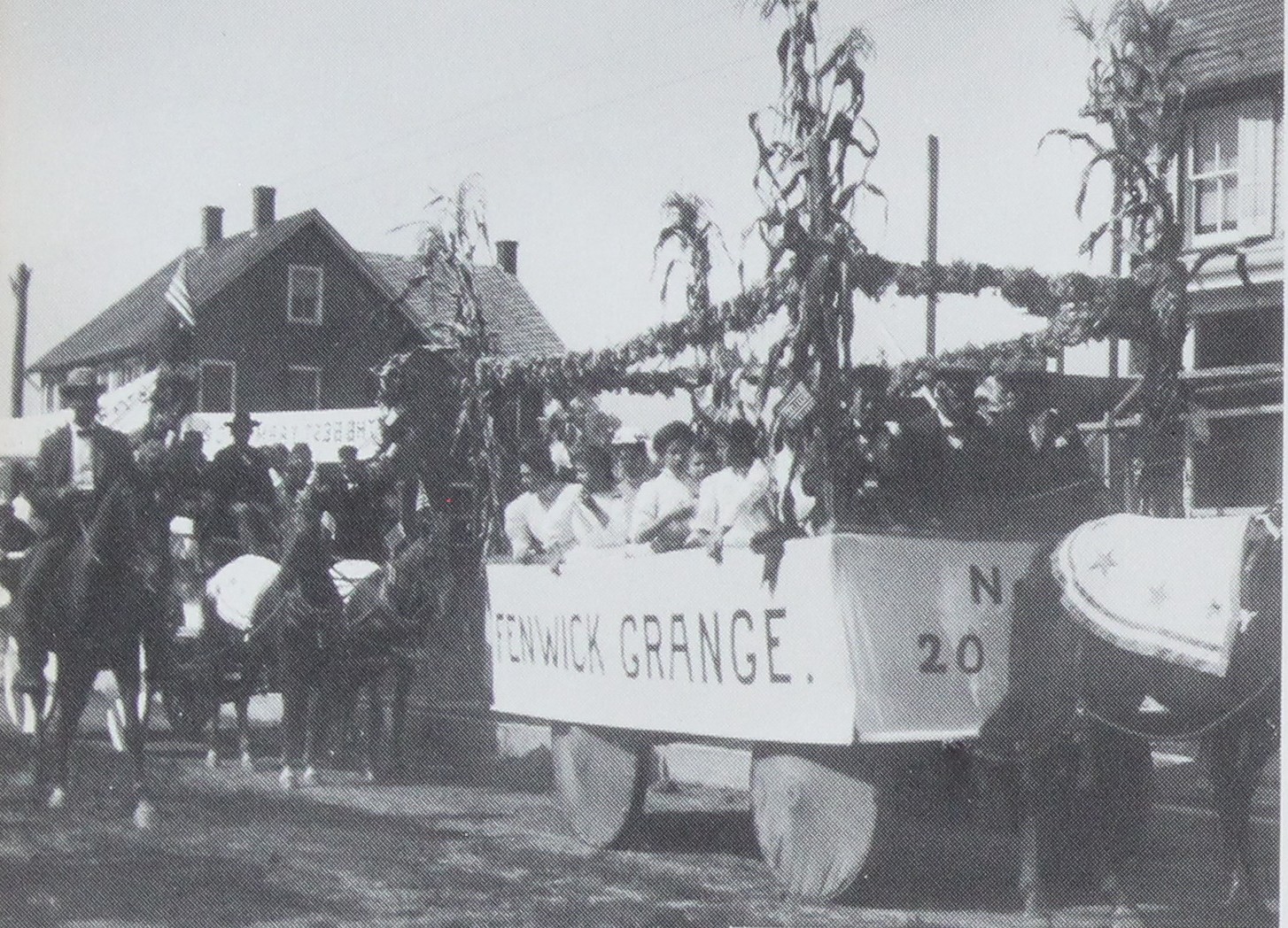

On October 5, 1909, the city hung bunting on the bank, the farm country sent in its decorated wagons, and a man with a tripod camera photographed the whole of it.
SALEM – One hundred seventeen years ago today, on Tuesday, October 5, 1909, Salem held a carnival.
The parade came up the street in decorated farm wagons. The City National Bank stood at its corner swagged in bunting. Somewhere in town a small girl in a costume was photographed on a porch, looking thoroughly put out, and four more girls rode in from the country in a pony cart trimmed with flowers. We know all of this because one photographer was there with a large tripod camera and a box of glass plates, and because he wrote the date down.
The Fenwick Grange sent a wagon built out of the harvest
The float that holds the eye is the Grange’s.
A white banner is stretched along the side of the wagon bed, and the lettering on it is plain and hand-drawn: FENWICK GRANGE, and at the end, stacked, an N above a 20. Number 20. Whole cornstalks have been lashed upright at the corners of the wagon, tall enough to clear the heads of everyone aboard, and garlands are strung between them in long swags. The float was not decorated with a harvest theme so much as built out of the harvest itself; the crop was cut, stood upright, and carried through town in early October.
A row of figures sits along the wagon bed behind the banner, several of them in white, looking out at the camera. Alongside at the left, men in hats ride on horseback, and some of the horses are draped in light-colored cloth. Behind the float, a crowd fills the sidewalk. A gable-roofed frame house flies a flag; a two-story building stands at the right of the frame; telephone or electric poles run up the street, and wires cross overhead. The street itself is unpaved.
Four more wagons came with it
The Grange was not alone. The parade ran to at least five decorated wagons, and the book preserves each of them under its own short caption.
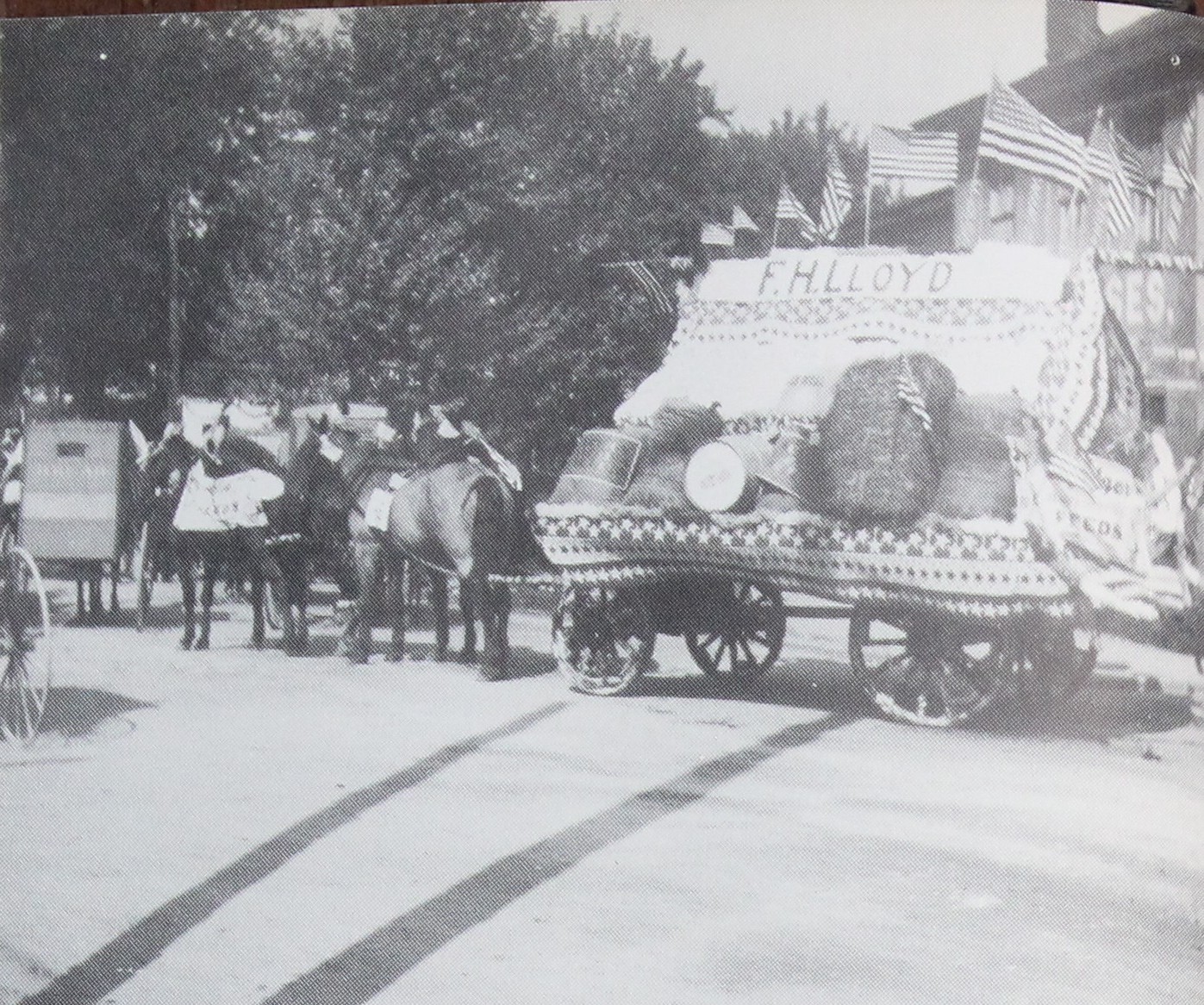
F. H. Lloyd’s Float is a two-horse wagon heaped with produce, a squash the size of a washtub riding at the center of it, the whole bed trimmed in scalloped ruffle work with the name lettered on a banner above. Flags hang from the building behind.
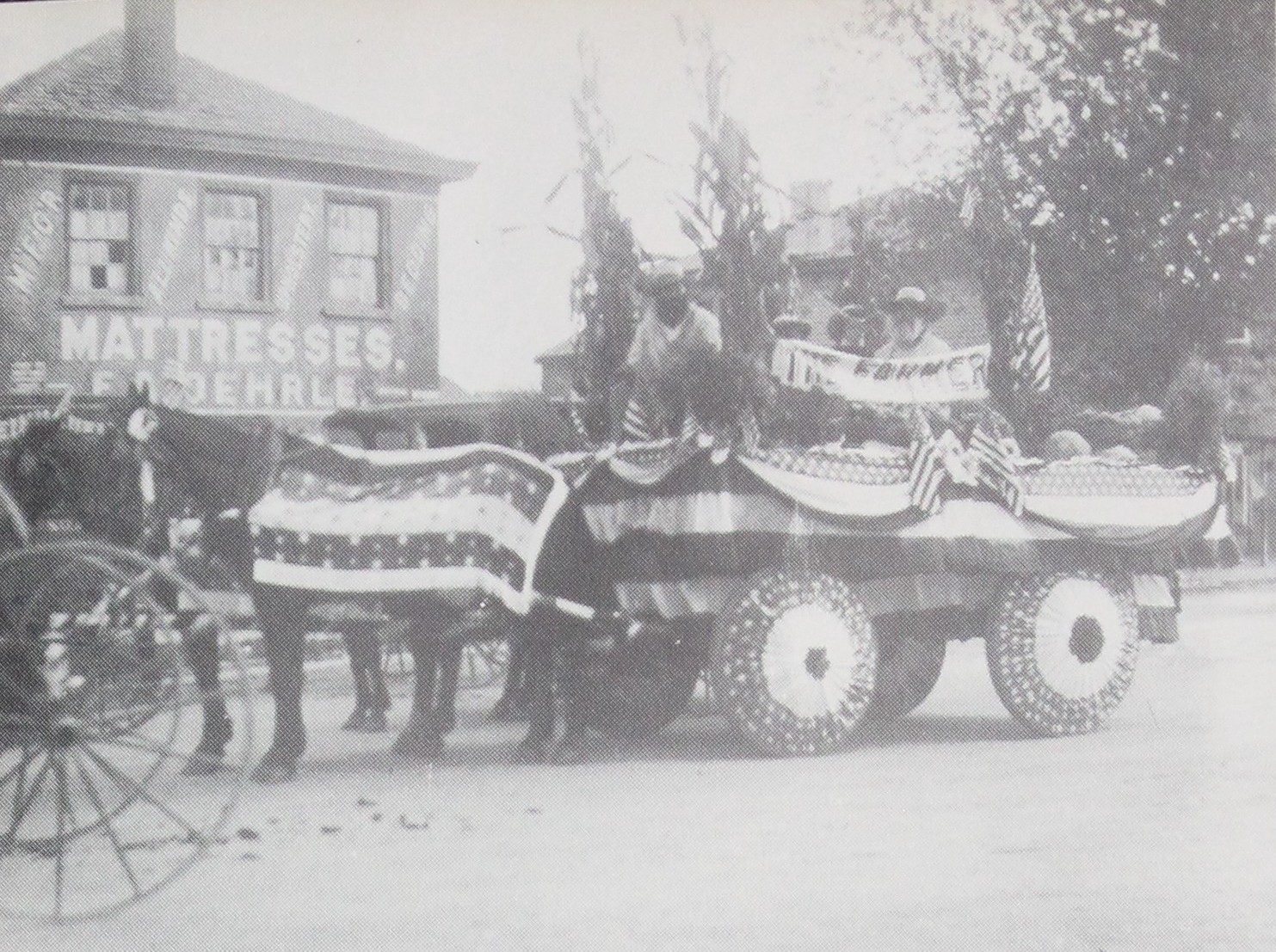
The Farmers Float was photographed passing a storefront painted MATTRESSES over the name MEHRLE, its wagon bed draped in striped bunting and even its wheel spokes wrapped in decoration, with small flags fixed along the side.
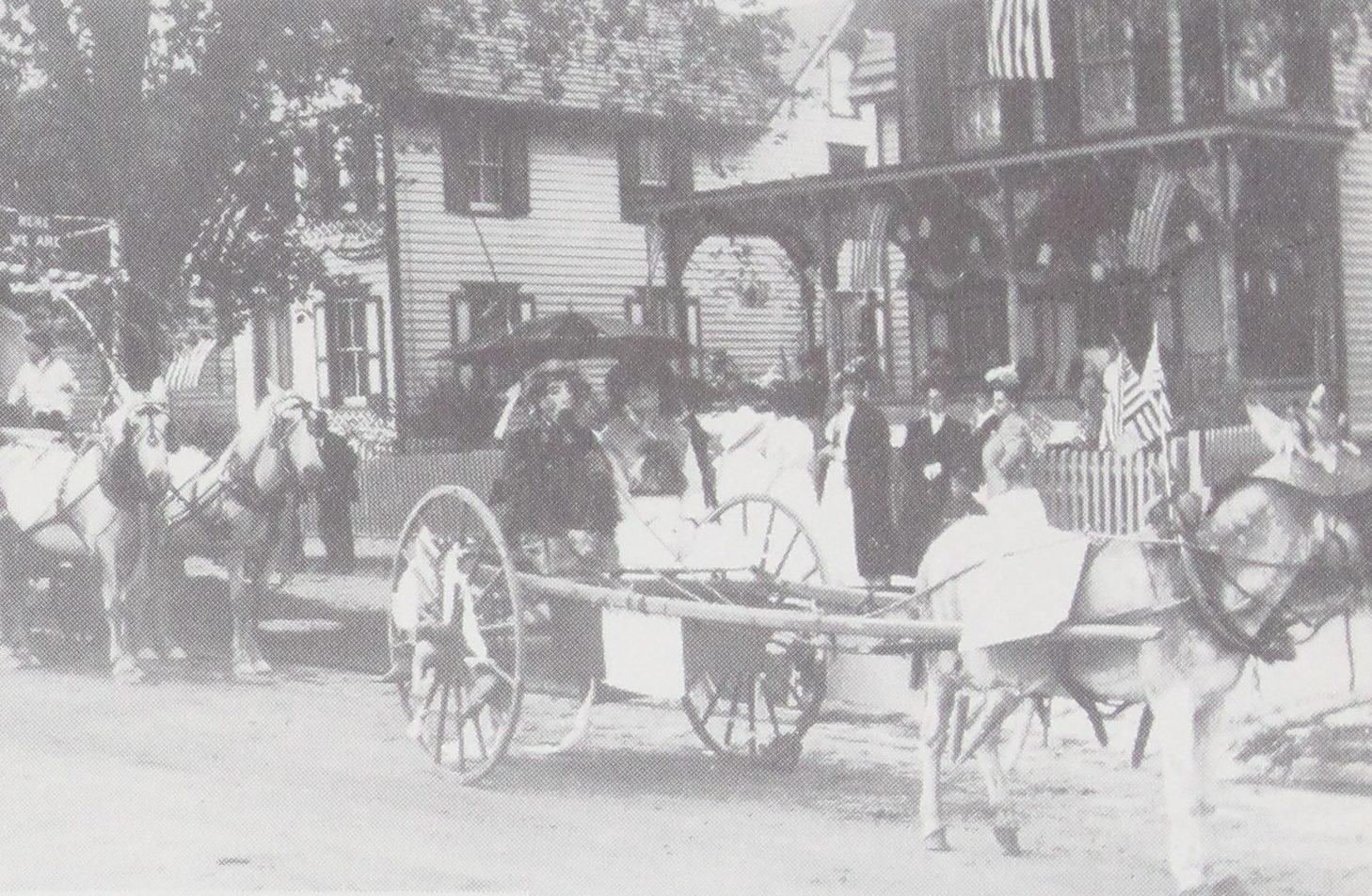
The Donkey Float sits in a street scene rather than a parade shot. A cart stands in the road, a woman holds a parasol, and behind them a large porched house is hung with flags and bunting, with a street sign at the corner.
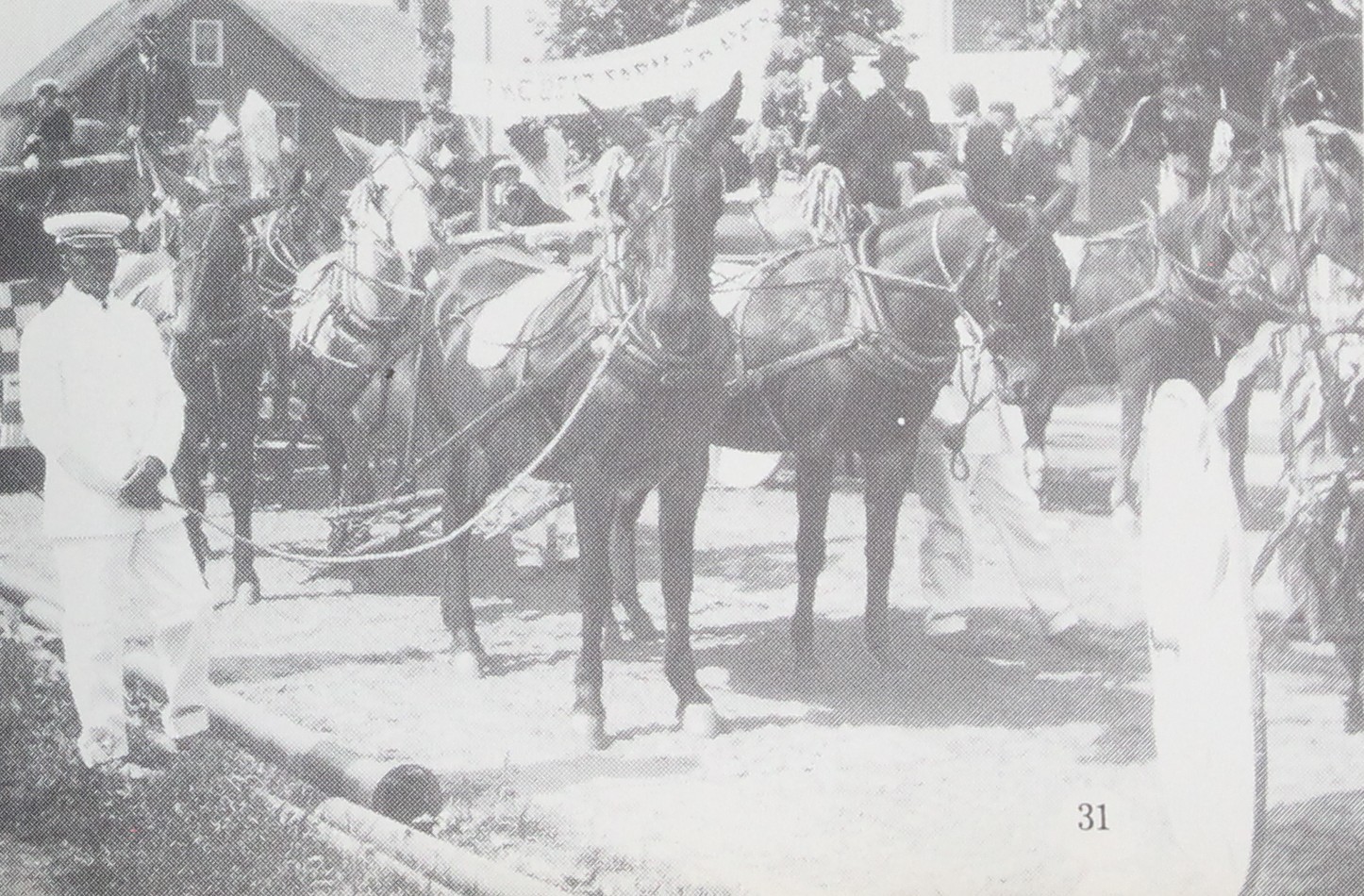
The Hiresdale Float catches the team rather than the wagon. Horses stand harnessed and waiting, a man in white holds the near one, and a banner is strung above the crowd behind them, too faint in the printing to read.
The wagon came from Harmersville, and the Grange behind it was fifteen years old
Fenwick Grange No. 20 was not a Salem city organization. It belonged to Harmersville, and its story is told elsewhere in the archive, in Fond Recollections.
The farmers of Harmersville and the surrounding country organized their Grange in January 1894, under the Patrons of Husbandry. The first slate of officers reads like a roll call of the neighborhood: Winfield Patrick as Master, Josiah P. DuBois as Overseer, William W. Carll as Secretary, Joseph B. Anderson as Treasurer, Joseph Stewart as Steward, David Elwell as Assistant Steward, and Joseph Ayars as Chaplain. The Grange seated women in its offices from the start, and four of them held titled positions: Mrs. Anna Smith as Lecturer, Mrs. Hannah Patrick as Ceres, Mrs. Hannah Brown as Pomona, and Mrs. Hannah Stewart as Ladies Assistant Steward.
They did not rent a room. The Grange bought a lot in the center of Harmersville and put up a two-story building, twenty feet by thirty-six, with horse sheds in the rear; members drove in from the Canton and Cross Roads neighborhoods, and their teams needed somewhere to stand. The lot had a prior life. Back in the 1880s, John F. Kates’ cider press had stood on that same ground, pressing apples that farmers hauled in from far and near.
So when that wagon went through Salem in October 1909, the Grange behind it was fifteen years old, it had its own building, and it drew from a membership the archive describes as large. It kept holding regular meetings for thirty-seven years.
The city put on bunting, and the children put on costumes
Turn the page and the camera leaves the parade route.
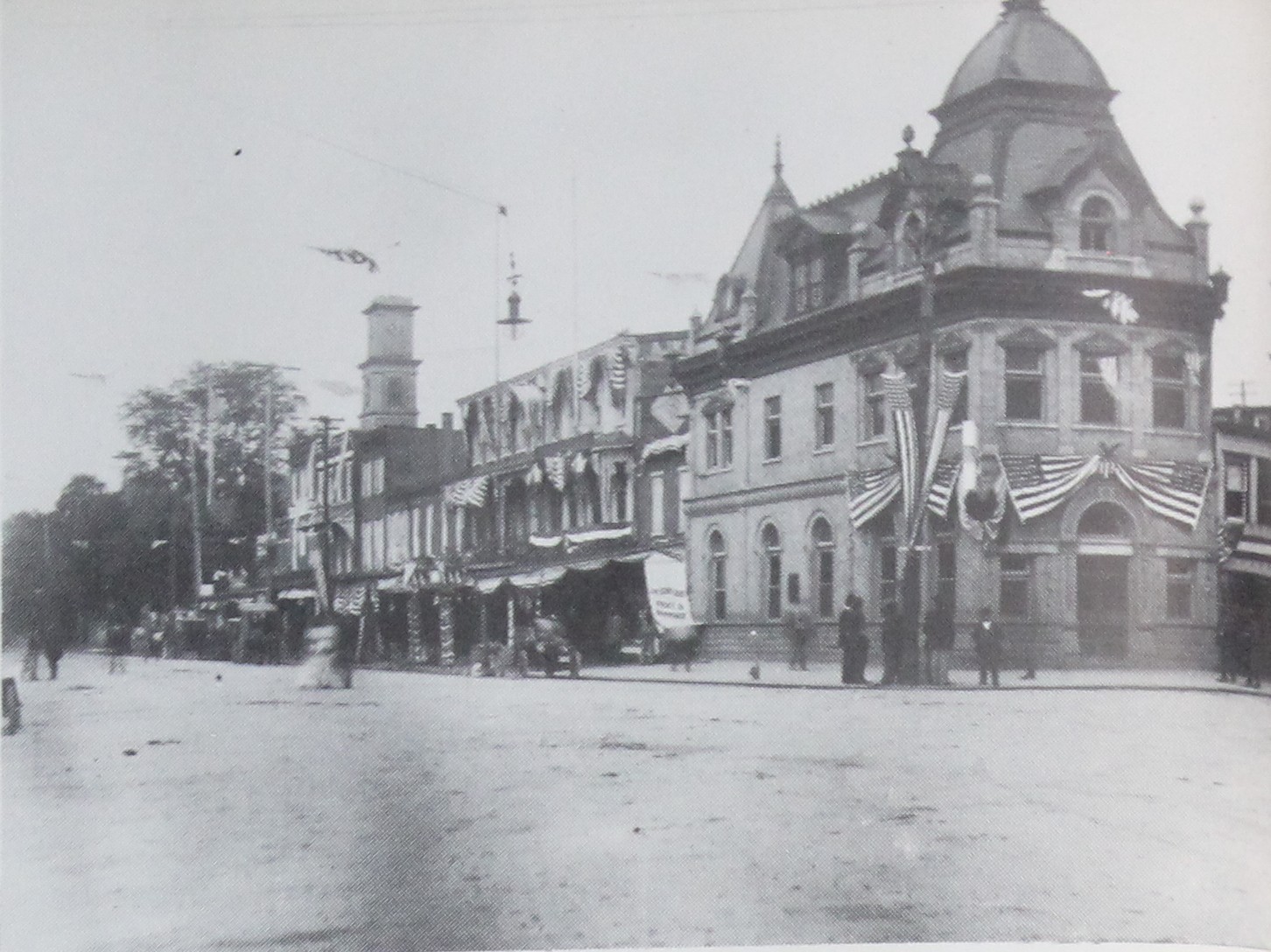
The City National Bank stands at its corner under flags and swagged bunting, with Grocery Row running down the block behind it beneath a line of awnings and a clock tower rising in the distance. The caption is dry and perfect: “City Natl. Bank Dressed up a little with Grocery Row in Back.”
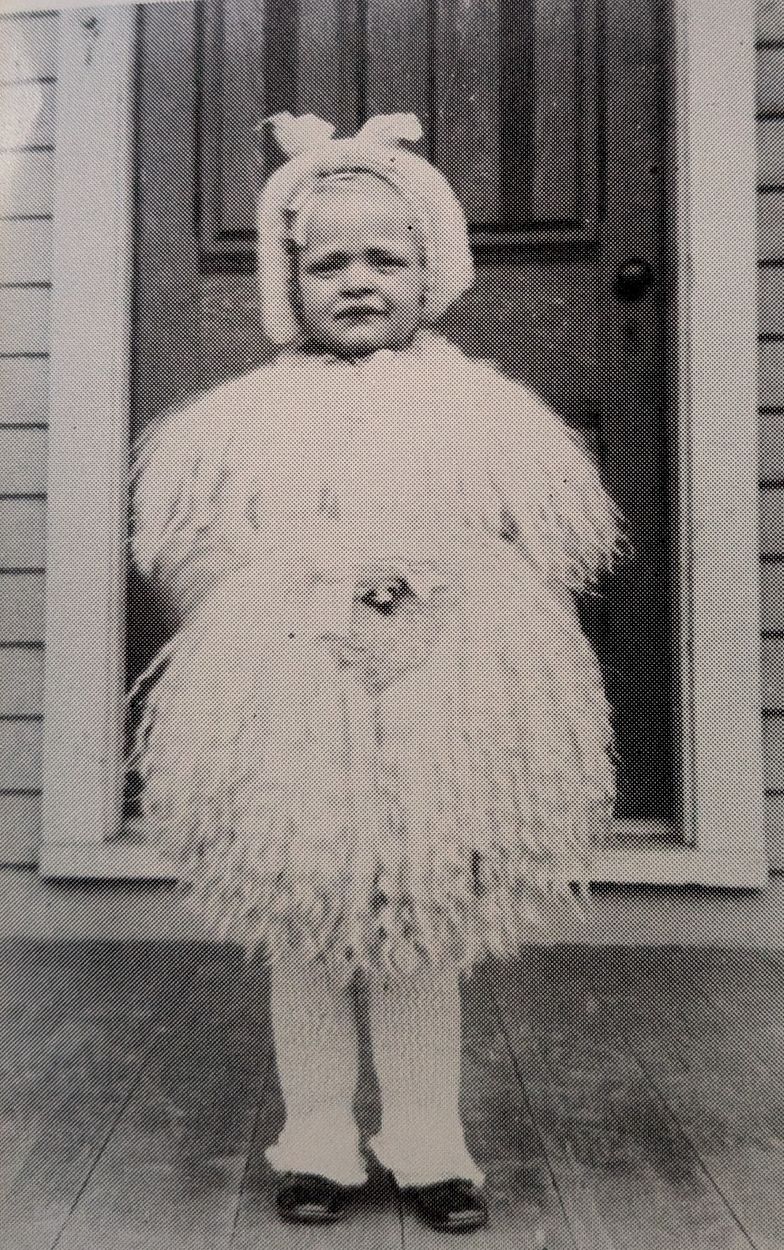
A small girl stands on a porch in front of a screen door, wearing a shaggy fringed costume and a bonnet with ears, in white stockings and dark buckled shoes, wearing an expression that needs no explanation. The caption supplies one anyway, and it is the best line in the book: “Mildred Plummer all dolled up for the carnival and nobody to take her there.”
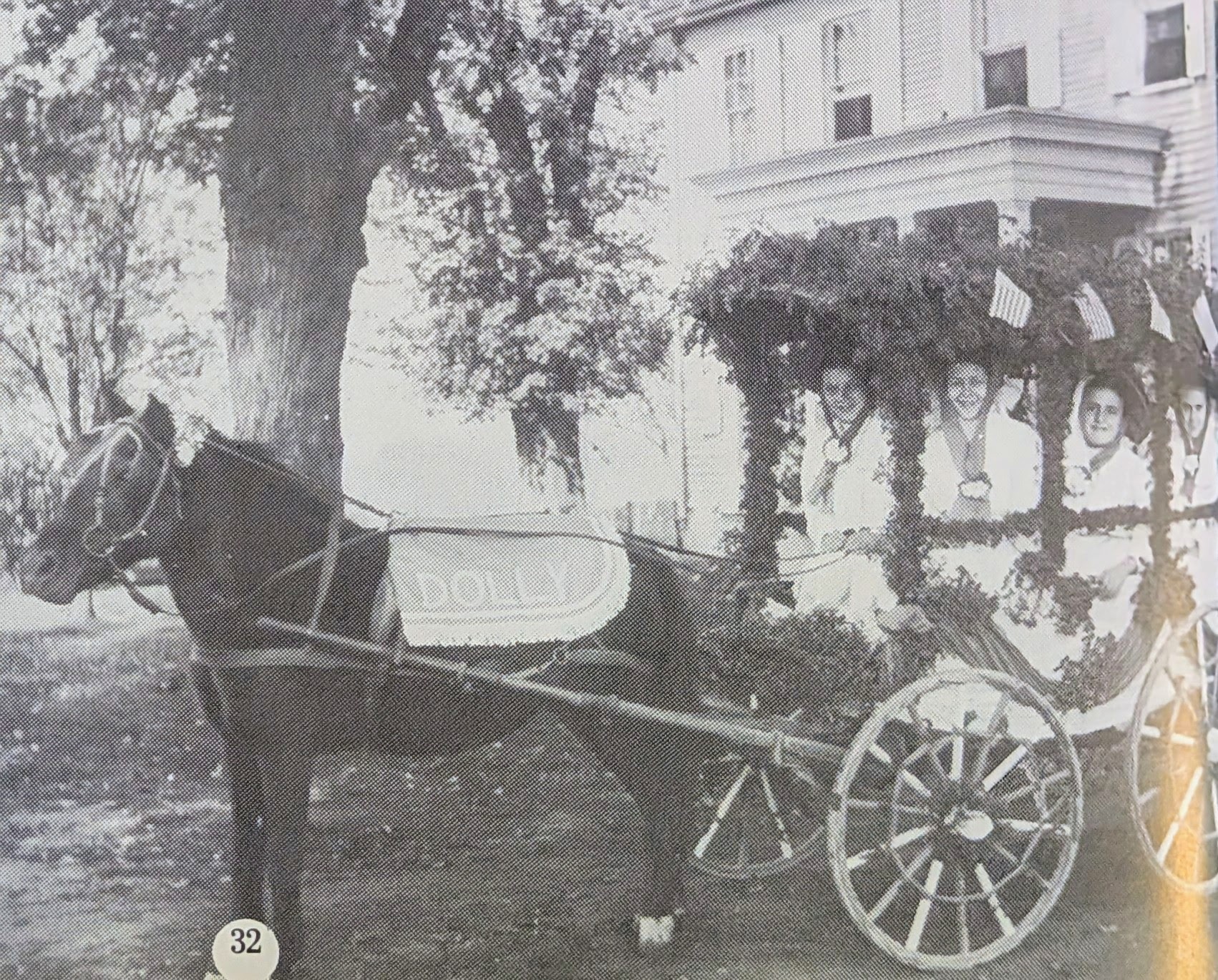
And four girls ride in a flower-decked pony cart, the pony’s blanket lettered DOLLY, under the caption “Four Lovely Farmers’ Daughters on their Way to the Carnival (Not Identified).” They were coming in from somewhere out in the country, dressed for the day.
Not one person in the photographs has a name
Mildred Plummer is the exception, and she is the only one. And, according to the caption in the book, she got “all dressed up” for nothing as she was left without a ride in Harmersville.
Nobody on the Grange wagon is identified, not the riders, not the figures seated behind the banner, and not the horsemen alongside. The farmers’ daughters are marked “Not Identified” in the book itself. The crowds on the sidewalks are crowds. The officers listed above are the Grange’s founding slate from 1894, and there is nothing in the record tying any of them to the float fifteen years later.
The book does not say what route the parade followed, what else the carnival offered, how many people came, or whether any float took a prize. What survives is the look of the day and the date it fell on.
Mildred Plummer, for what it is worth, turns up again two pages earlier, named in the Canton School class photograph, standing in the front row.
The day survives because one man dated his plates
All of this reaches us through William J. S. Bradway of Hancocks Bridge, known around the county as the Home Photographer.
Bradway took up photography seriously around 1905 and worked with a large tripod camera on four-by-five and five-by-seven glass plates. The biography of him printed in the companion volume is specific about his method; he carefully preserved and dated each exposed plate. The October 1909 date on these pictures survives because Bradway himself wrote it down, at the time, on the glass.
In 1914 the cheap mass-produced cameras coming out of Eastman Kodak and its competitors took his business apart. That same year his father, his sister and his brother-in-law moved to Roadstown, and Bradway went with them. He became active in the Cohansey Baptist Church there and started writing for the Salem Standard and Jerseyman and the Bridgeton Evening News, including the series “Journeys Around Jericho.”
He died on July 11, 1939, of a heart attack, while working in his garden. His plates were bought out of the estate by a fellow townsman, Howard Hewitt, who kept them safe; they were published at last in How Dear to My Heart, edited by William Bradway Vanneman, in 1976.
That is the whole chain. A carnival happened on a Tuesday in October, a man with a tripod recorded it and labeled what he had, somebody bought the plates instead of letting them go, and somebody else put them in a book thirty-seven years later. Take away any one link and this day is gone without a trace. What we have instead is a street full of corn-trimmed wagons, a bank dressed up a little, and a little girl in a costume with nowhere to go.
**A special thanks to LAC Twp. for allowing The News of Salem County to republish the above photos from Bradway’s books