

With most towns too small to get settlement money of their own, the county controls nearly every dollar meant to fight the opioid crisis here. Records show the biggest expense so far was a building.
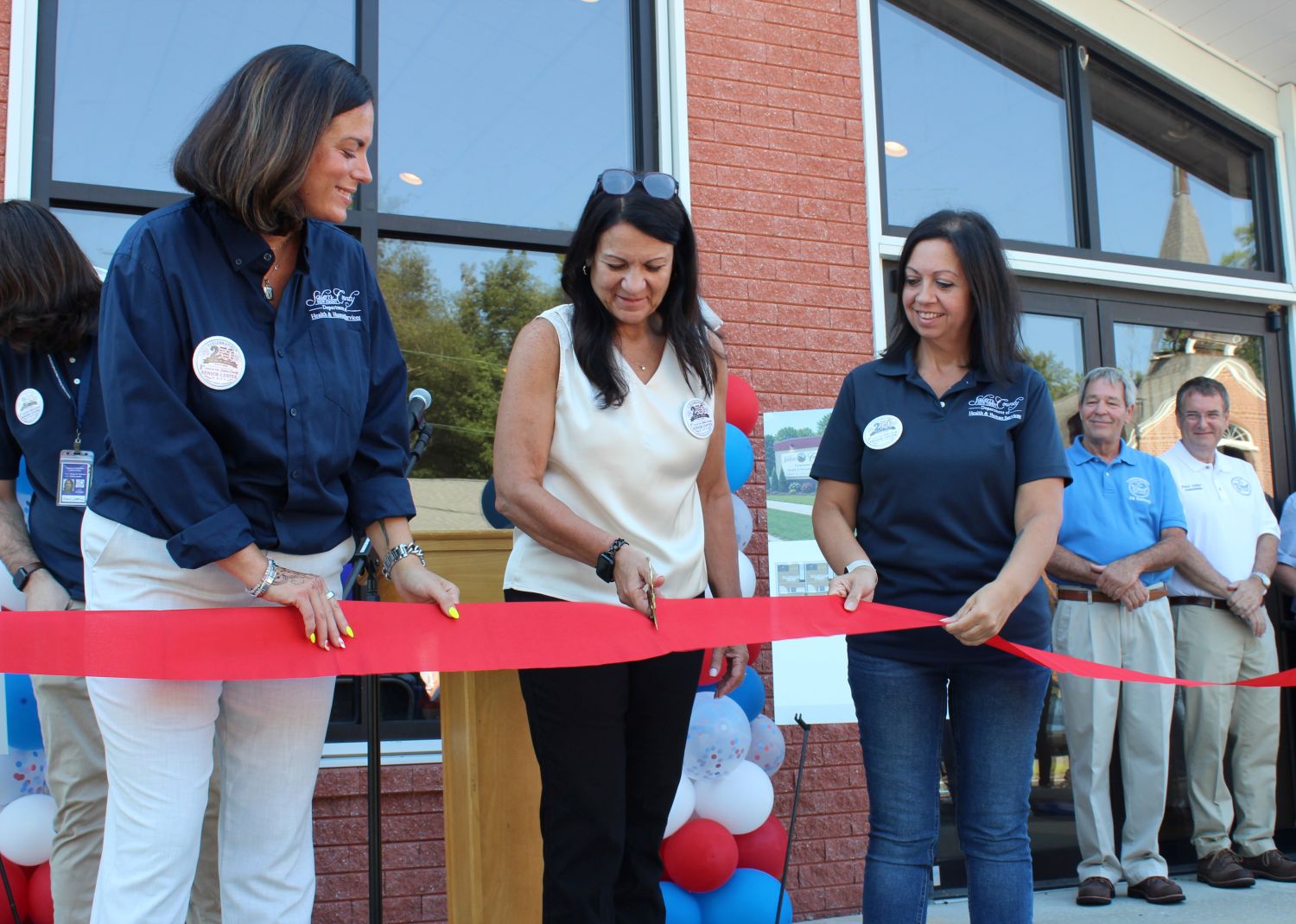
SALEM COUNTY — Salem County used about $605,000 in national opioid settlement money to help buy the former Sharptown United Methodist Church, the building that opened in August as the county’s new senior and community center, according to county records and the county’s Health and Human Services director.
The county also charged $123,237 in opioid settlement money toward a $224,270 emergency generator for the building, a purchase the director acknowledged “is not a direct treatment or recovery service.”
The settlement money comes from drug makers, distributors and pharmacy chains that settled lawsuits over their role in the opioid epidemic. Under state rules, it must go toward approved opioid prevention, treatment and recovery uses. Salem County has had one of the highest overdose death rates in New Jersey.
None of that funding was mentioned when the building opened.
What the records show
On Jan. 21, the Board of County Commissioners adopted Resolution 2026-044, authorizing the purchase of 24 Church Street for $925,000 and the adjacent lot at 8 Chapel Street for $55,000, both in Pilesgrove Township. The resolution says the property would house “a senior citizen center, as well as additional office space to house various aspects of County Government including divisions of the Salem County Department of Health and Human Services.”
It also states: “the County will fund the said purchases through Opioid Litigation Settlement funds and Community Development Block Grant CARES Act funding, the result of which results in no additional costs to county taxpayers.”
Two weeks earlier, at the board’s Jan. 7 reorganization meeting, Director Ben Laury told the public the senior center “will be purchased with grant funds,” according to the meeting minutes. The county’s announcement of the purchase said it was made “using special purpose funds and grant support.” Neither mentioned opioid settlement money.
The county closed on the property Feb. 20, Laury said at the March 4 meeting.
In August, the county reported its opioid spending to the state for the fiscal year that ended June 30. Of the $691,705.73 it spent, $643,214.13 was listed under “Recovery Supports.” The report says the building was “in part funded by the opioid abatement funds as we move toward the establishment of a community clinic to provide health services and ongoing recovery supports.”
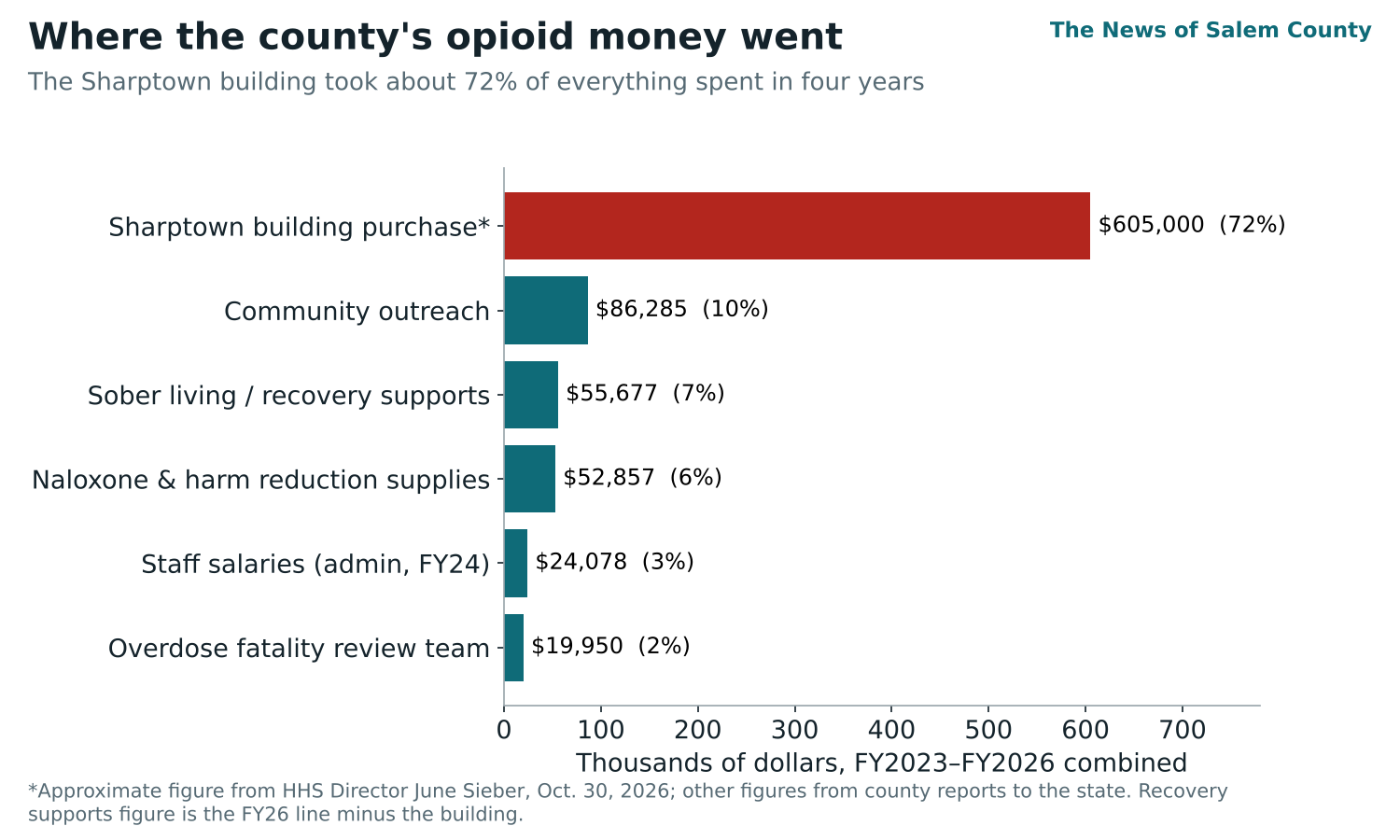
Source: Salem County annual opioid abatement reports to the N.J. Department of Human Services, FY2023–FY2026; building figure from HHS Director June Sieber, Oct. 30, 2026 (approximate).
What the county says
In an email Friday, Health and Human Services Director June Sieber said the purchase of 24 Church St., 8 Chapel St. “and a lot on Green St.” was paid for with “approximately 605,000 from opioid settlement funds and 429,730 from CDBG-CV2 funds.” The Green Street lot, she said, provides additional parking and room for a possible new septic system.
Those two figures total $1,034,730, about $54,730 more than the $980,000 authorized in Resolution 2026-044, which does not mention a Green Street lot. The News of Salem County has asked which resolution authorized that purchase and how it was paid for.
Asked why opioid money was used for a building whose main public uses are senior services and a polling place, Sieber said the facility “provides a central location for programming” that “extends much further than senior services and a polling place.” She said the purchase falls under “the core strategies for prevention, harm reduction, education, recovery support, trainings, and other services that address the needs of our community.” She did not name a specific approved use from the state’s list.
She said programs now operating at the building include recovery coaching and support services, CPR, first aid and Narcan training, recovery events, youth and adult grief counseling, and harm reduction programs. Planned for 2027 are crisis intervention training for law enforcement, prevention events for teens, and the county’s Opioid Summit.
The clinic described in the state report is “still in discussions and planning phases,” Sieber said, describing it as “clinic space for screenings and testing.” Services are now provided by the county’s nursing division with partners Cooper Medical and FamCare.
On the generator, Sieber wrote that it keeps vaccine refrigerators and freezers running during outages. “While the generator itself is not a direct treatment or recovery service, it provides critical infrastructure to support the continuity of public health services and programming,” she said.
Sieber said she was celebrating the building’s opening at the August ceremony and “did not mention all of the programs,” adding, “I apologize if my remarks during the ceremony seemed to focus primarily on the senior programs.”
Most towns get nothing directly
New Jersey splits its settlement money evenly between the state and local governments. Only counties and towns with more than 10,000 residents, or that filed their own lawsuits, receive a direct share.
In Salem County, that means the county and one town. Pennsville, with about 12,700 residents, is the only municipality in the county that gets its own payments. The other 14 towns, including Salem City, Penns Grove, Carneys Point, Pittsgrove, Upper Pittsgrove and Elmer, receive nothing directly. The county is the steward of the money on their behalf.
Pennsville reported to the state that it has received $36,361.89 since 2022. Its only reported spending is $2,615.10 for its 2023 National Night Out, listed with the police department as the recipient. The township reported about $36,000 still on hand as of June 30, with no plan for it and no public input.
Pennsville Police Chief Nick Bowen said his department has not seen any of the settlement money or been offered any of it in its budget, since he has taken office which was earlier in 2026.
Neither the county’s nor Pennsville’s reports describe any process for towns, police departments or schools to request settlement money, or any coordination between the county and municipalities on how it is spent.
The amounts at stake grow over time. According to projections from the court-appointed administrator of the national settlements, Salem County is expected to receive about $5.13 million in all through 2038 from the seven largest settlements. About $2.08 million has been paid so far, and about $3.05 million is still to come. Pennsville is projected to receive about $187,000 in all.
The administrator’s records show about $75,800 paid to Pennsville so far, more than double the $36,361.89 the township reported receiving as of June 30. Some of the difference may be payments made after June 30. The News of Salem County has asked the township to explain the gap.
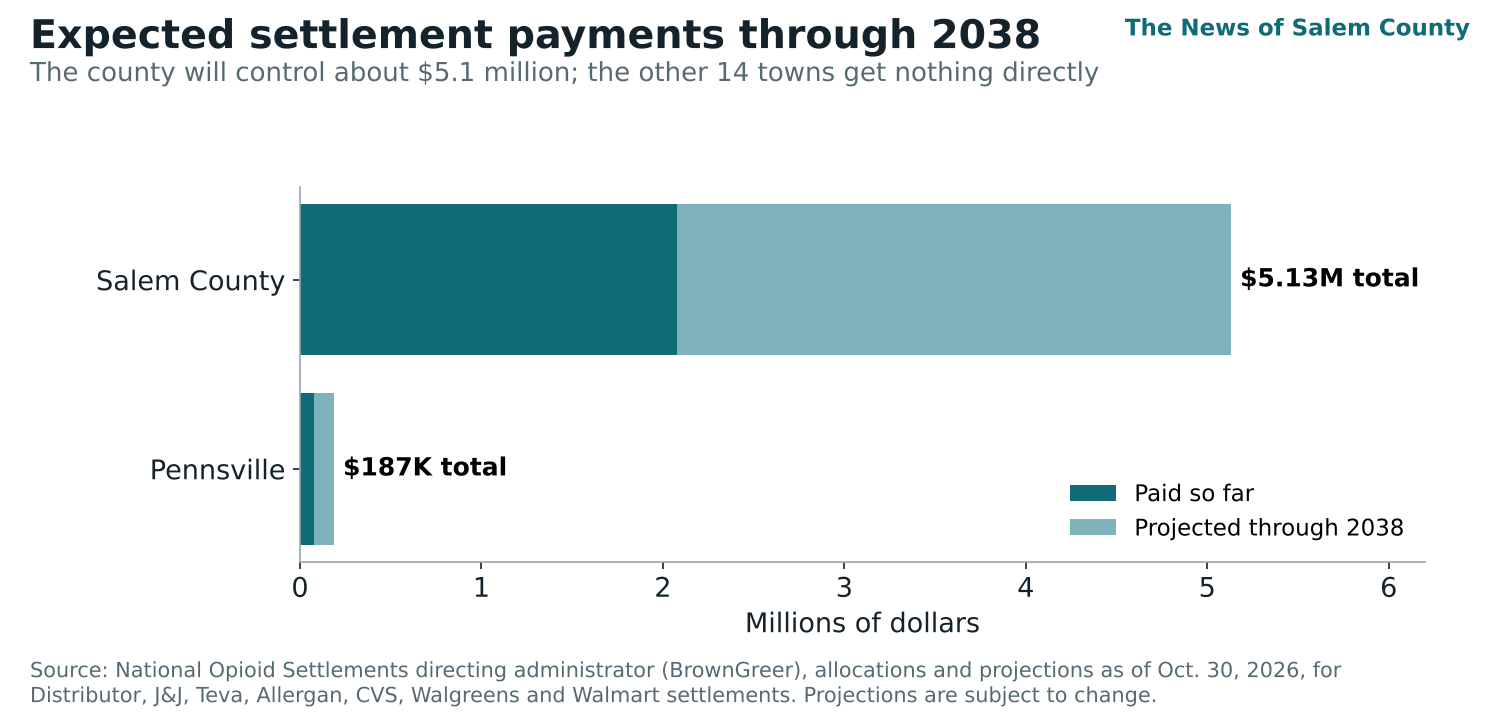
Source: National Opioid Settlements directing administrator (BrownGreer), New Jersey allocation data as of Oct. 30, 2026, for the Distributor, Johnson & Johnson, Teva, Allergan, CVS, Walgreens and Walmart settlements. Projections are preliminary and subject to change.
The true toll of the opioid epidemic on Salem County
The money is meant for a county that has been hit hard. Salem County’s overdose death rate in 2022 was 41.5 per 100,000 residents, sixth-highest of New Jersey’s 21 counties and well above the state rate of 32, according to CDC data compiled by USAFacts. The county’s deaths peaked at 43 in 2019, according to the county’s Overdose Fatality Review Team, and the state counted 28 suspected overdose deaths in 2023.
Those deaths are spread across the county. Among the 30 deaths the review team examined between July 2023 and June 2024, Salem City and Carneys Point each accounted for 20%, and Pennsville and Elmer each accounted for 13%. Nine of those who died left children under 18 behind, 29 children in all.
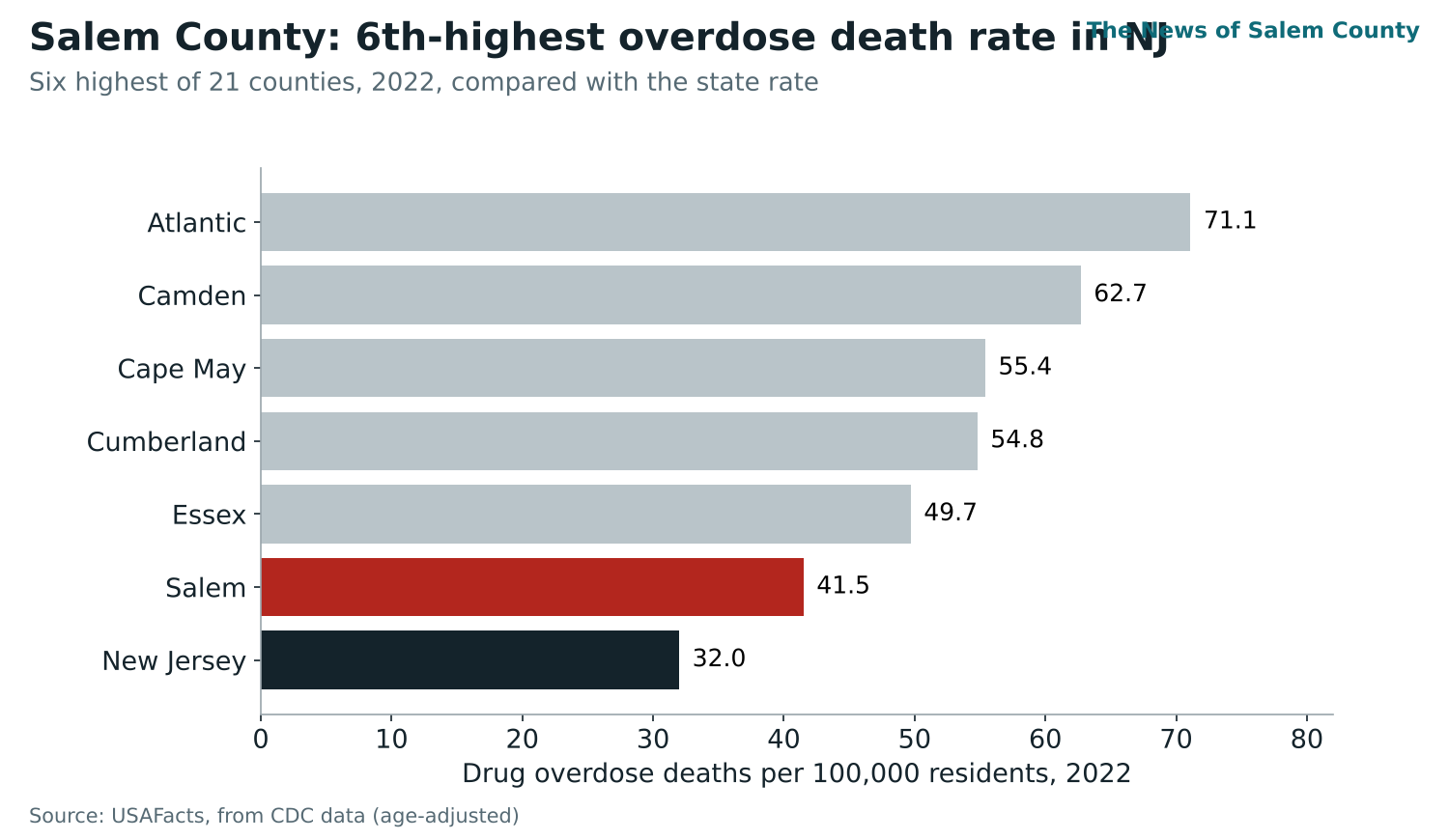
Source: USAFacts, using Centers for Disease Control and Prevention data (age-adjusted rates, 2022).
Treatment numbers point to the same towns. In 2024, Salem County residents were admitted for substance use treatment 1,052 times, according to the state Division of Mental Health and Addiction Services. That is about 16 admissions per 1,000 residents, nearly twice the statewide rate of about 9 per 1,000. Upper Pittsgrove, Elmer, Salem City and Penns Grove had the highest rates, three to five times the state rate, and none of them receives settlement money directly.
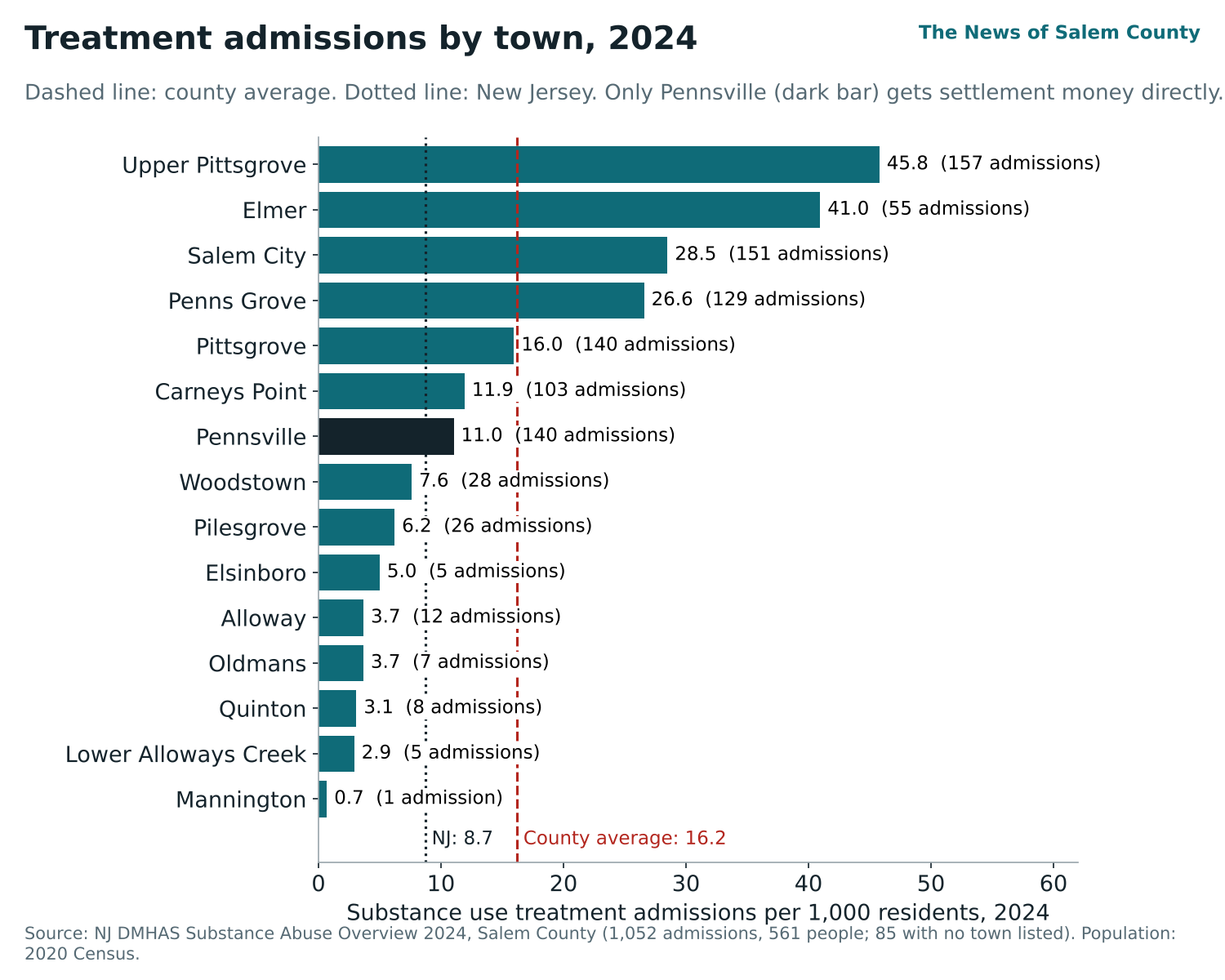
Substance use treatment admissions per 1,000 residents in 2024, by town of residence. The county averaged 16.2 admissions per 1,000 residents, nearly twice the statewide rate of 8.7. Only Pennsville receives settlement money directly.
And almost none of that treatment happens here. Only 22 of the 1,052 admissions, about 2%, were at programs inside Salem County. Residents went to Gloucester County 458 times, Atlantic County 176 times and Cumberland County 138 times.
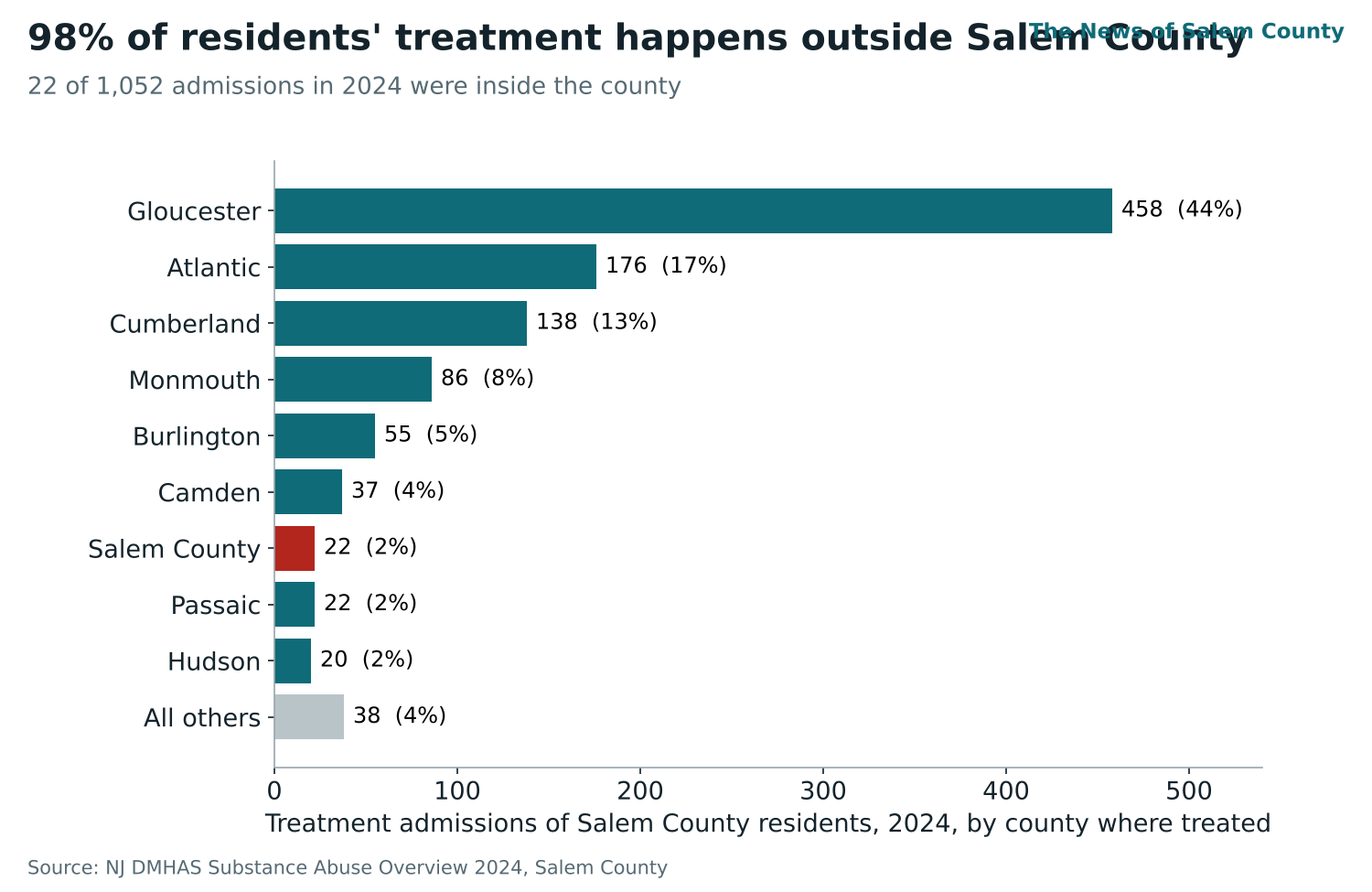
Source: N.J. Division of Mental Health and Addiction Services, Substance Abuse Overview 2024, Salem County.
Questions that remain
The county reported $1,225,044.59 in unspent settlement money as of June 30, and payments will continue through 2038. Its reports to the state say it has no strategic plan for the money and did not seek public input in either of the last two years. The members of its Opioid Settlement Advisory Committee, which decides how the money is spent, are not named in the reports.
Sieber said the unspent balance reflects care. “I believe the fact that we have unspent funds is also a testament to how carefully we approach spending,” she said. “We are being strategic and thoughtful about how the money is allocated rather than rushing to spend it.”
She said the county’s commissioners and administration understand “that these funds must be used responsibly and for services that address the needs of individuals and families impacted by substance use and addiction,” and that the county recognizes its responsibility “as a steward of these resources on behalf of our municipalities and residents.”
The county has not said whether people in early recovery, or still using, have private space, separate hours or a separate entrance at a building that serves mainly as a senior center and polling place, or whether anyone in recovery or any treatment provider was consulted on the site. The News of Salem County has sent follow-up questions to the county, including the Green Street purchase, how much of the building is used for opioid-related programs, and the plan for the unspent balance.
Statewide, advocates told an Assembly oversight committee on Oct. 22 that New Jersey lacks guardrails on how settlement money is spent. A bill introduced Oct. 5, A5588, would expand state oversight and transparency of state and local settlement spending. It has been referred to the Assembly Oversight, Reform and Federal Relations Committee.
The News of Salem County is in the process of filing records requests for the closing documents, funding records and advisory committee records related to the county’s opioid settlement spending.
Sources: Salem County Resolutions 2026-044 and 2026-407; Board of County Commissioners minutes, Jan. 7 and March 4, 2026; Salem County and Pennsville annual opioid abatement reports to the NJ Department of Human Services, FY2023 to FY2026; email from HHS Director June Sieber, Oct. 30, 2026; National Opioid Settlements directing administrator (BrownGreer) allocation data; NJ DMHAS Substance Abuse Overview 2024, Salem County; Salem County Overdose Fatality Review Team reports; USAFacts/CDC.